Reading Philippians 2:5–11 as Paul Intended
Few passages in Paul’s letters have been quoted more often—or misunderstood more easily—than Philippians 2:5–11. Often lifted out of its literary and pastoral setting, this so-called “Christ hymn” is treated as a self-contained doctrinal statement about incarnation or divine ontology. Yet Paul does not introduce this passage to settle metaphysical debates. He places it precisely where he does because it redefines the moral imagination of the Christian community.¹
This hymn is not an interruption in Paul’s argument. It is its theological center of gravity.
A Song with a Purpose
Paul introduces the hymn with an unmistakably ethical frame: “Have this mind among yourselves, which was also in Christ Jesus” (Phil 2:5). The hymn is not offered for admiration but for imitation. Its concern is not abstract christology but communal formation. The question it answers is not simply who Christ is, but what kind of life follows when a community belongs to him (cf. Rom 15:3).
The immediate context matters. Paul has just named the corrosive forces that threaten communal life—selfish ambition and empty glory—and has urged the Philippians to look to the interests of others (Phil 2:3–4). The hymn follows not as ornament, but as justification. Christian humility is not a moral ideal imported from philosophy; it flows directly from the story of the Messiah.
Status Not Exploited
The hymn begins with Christ’s status, not his humility. Christ is said to be “in the form of God” (Phil 2:6). Paul does not pause to define this metaphysically. His interest lies elsewhere: what Christ does with this status.
Rather than exploiting it, Christ refuses to treat divine status as something to be used for self-advantage. In a world structured by honor, where status existed to be displayed and defended, this is a radical inversion. Power, in this vision, is not something to be clutched but something that can be given away.²
This is already a critique of the behaviors Paul has warned against. Rivalry and self-assertion are not neutral personality traits; they are denials of the gospel’s deepest logic.
The Meaning of “Emptying”
The phrase “he emptied himself” (Phil 2:7) has often been misunderstood as a statement about Christ’s loss of divine attributes. Paul offers no such speculation. The “emptying” is defined narratively, not philosophically.
Christ empties himself by taking the form of a slave. The self-emptying is not subtraction but addition—not because divinity is reduced, but because God does something unprecedented. God does not stop being God; God becomes human. The hymn does not describe a shedding of divinity, but the assumption of real humanity—embodied life marked by vulnerability, dependence, and obedience. In this sense, the “emptying” names not a loss of divine identity but the divine decision to live a genuinely human life, even to the point where obedience leads to suffering and death (Phil 2:7–8; cf. Rom 8:3). In Israel’s Scriptures, the servant is not the one without value but the one through whom God’s purposes advance (cf. Isa 52:13–53:12). Paul frames Jesus’ obedience as reaching its climax “to the point of death—even death on a cross” (Phil 2:8).
Crucifixion was Rome’s ultimate symbol of shame and erasure. Paul does not soften this. Faithfulness, in a world ordered by rival lordships, is costly (cf. Gal 3:13).
Exaltation as Vindication, Not Promotion
Only after obedience does exaltation appear—and even then, it is entirely God’s action: “Therefore God highly exalted him” (Phil 2:9). The sequence is crucial. This is not the logic of ambition, where humility becomes a strategy for eventual advancement. It is the logic of vindication.
God’s exaltation of Jesus is not payment for services rendered but public confirmation that this path—self-giving obedience rather than self-protection—is the true expression of divine faithfulness (cf. Acts 2:33–36).³
Therefore, the incarnation is not reversed at exaltation. The one whom God highly exalted is not a different Christ from the one who obeyed to the point of death. Paul’s hymn presupposes continuity, not replacement: the exalted Lord remains the crucified and risen human Jesus, now exercising divine lordship without ceasing to be human (Phil 2:9–11; cf. Acts 17:31).
The “name above every name” evokes Israel’s scriptural language of divine sovereignty (cf. Isa 45:23). Paul’s claim is not that Jesus replaces Israel’s God, but that God’s own lordship is now revealed and exercised through the crucified Messiah.
“The incarnation is not undone by exaltation: the Lord whom all creation confesses is the same Jesus who became human—and remains so forever.”
A Confession with Consequences
The universal confession—every knee bowing and every tongue confessing Jesus as Lord (Phil 2:10–11)—is not abstract worship language. In a Roman colony like Philippi, such language carried unmistakable political resonance. Allegiance to Jesus relativized all rival claims, including those of empire (cf. Phil 3:20).
Yet the hymn does not end in domination. Its final note is doxological: “to the glory of God the Father.” Divine sovereignty is revealed not in coercion but in self-giving faithfulness.
Why Paul Sang This Song Here
Paul places this hymn here because it grounds Christian unity in Christology, not in sentiment or organizational discipline. The church is not united by suppressing difference but by shared orientation toward the crucified Messiah (cf. 1 Cor 1:18–25).
Humility is not optional. It is the only posture consistent with the gospel Paul proclaims. The hymn tells the community that God’s future does not belong to the assertive or the self-protective, but to those willing to give themselves for others (cf. Mark 10:42–45).
The Church as the Echo of the Hymn
If Philippians 2:5–11 is reduced to a doctrinal checklist, it loses its force. Paul expects the church to become the echo of this hymn.
Where ambition governs leadership, the hymn is denied.
Where status determines worth, the hymn is silenced.
Where unity collapses under self-interest, the hymn is forgotten.
But where communities learn to bear one another’s burdens (Gal 6:2), to renounce rivalry, and to remain faithful under pressure, the hymn is not merely remembered—it is performed.
A Song Still Being Sung
Philippians 2:5–11 does not invite admiration from a distance. It summons the church to locate its life within Christ’s story. The question Paul leaves us with is not whether we affirm the hymn, but whether our communities sound like it.
The song that rewrites power still waits to be sung—not only with lips, but with lives.
Suggested Citation:
Palon, Lorenzo F., Jr. “The Song That Rewrites Power: Reading Philippians 2:5–11 as Paul Intended.” https://lorenzopalon.org/2026/02/10/the-song-that-rewrites-power/
Footnotes
- Gordon D. Fee, Paul’s Letter to the Philippians (NICNT; Grand Rapids: Eerdmans, 1995), 191–193.
- James D. G. Dunn, Christology in the Making (2nd ed.; Grand Rapids: Eerdmans, 1996), 114–121.
- N. T. Wright, The Climax of the Covenant: Christ and the Law in Pauline Theology (Minneapolis: Fortress Press, 1991), 83–97.
- Ralph P. Martin, A Hymn of Christ: Philippians 2:5–11 in Recent Interpretation and in the Setting of Early Christian Worship (Downers Grove, IL: IVP Academic, 1997), 37–52.
- Michael J. Gorman, Inhabiting the Cruciform God (Grand Rapids: Eerdmans, 2009), 9–27.
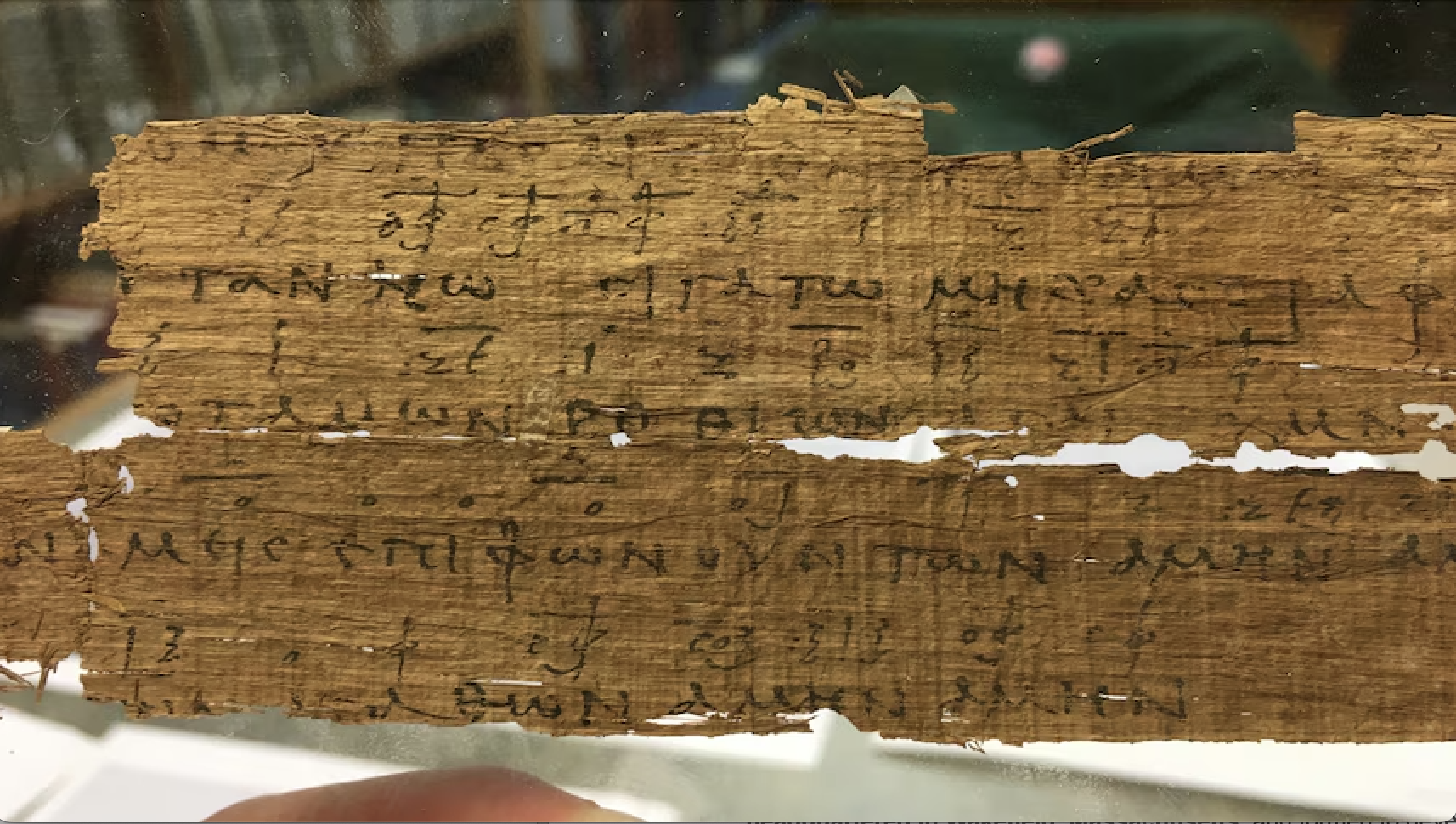
Image credit: Papyrus Oxyrhynchus XV 1786 — commonly known as The First Hymn, the earliest surviving Christian hymn with musical notation. Courtesy of the Egypt Exploration Society.
Leave a Reply