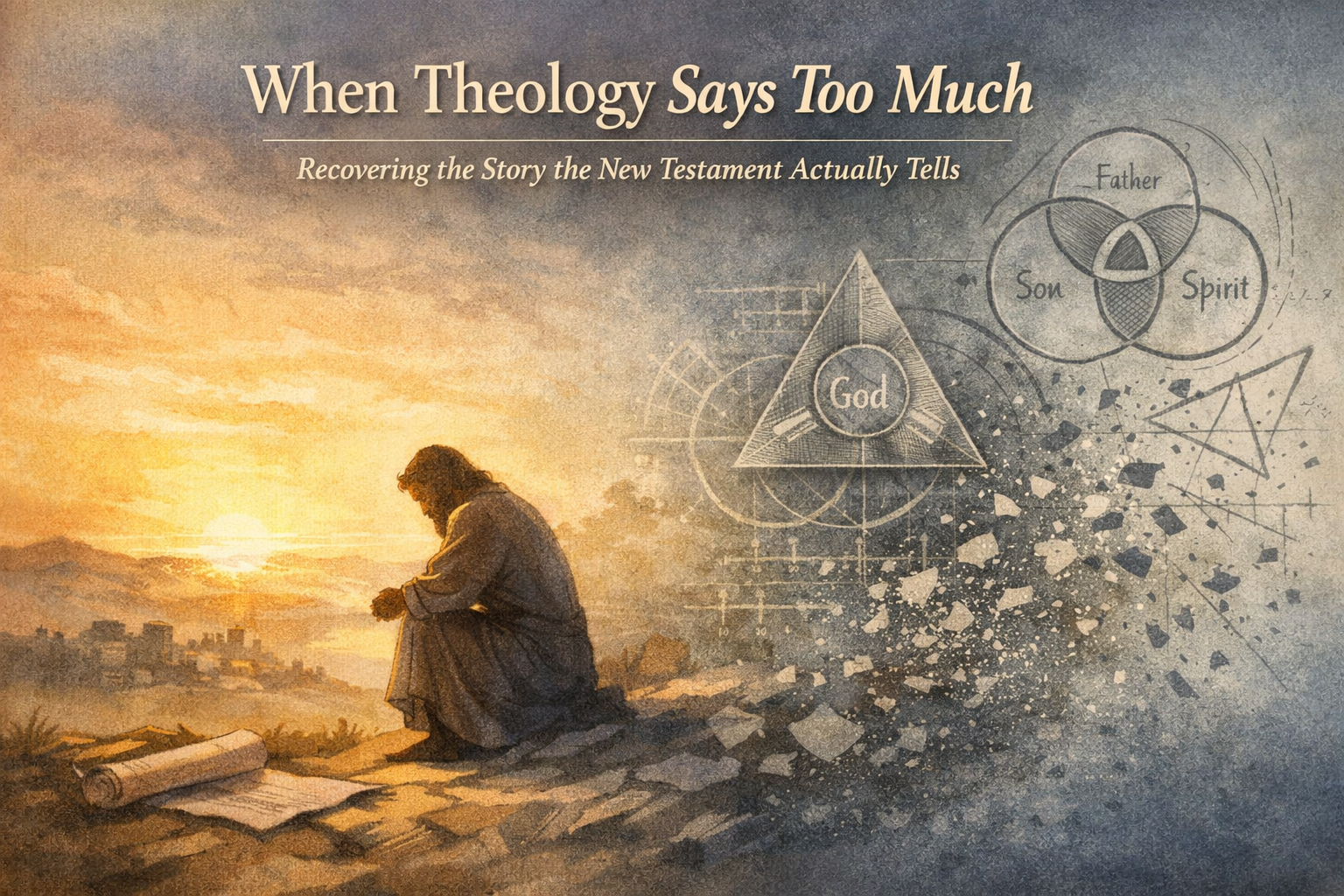
The Danger of Explaining More Than Scripture Explains¹
One of the recurring temptations in Christian theology is the urge to explain Jesus using terms the New Testament never employs². We reach for metaphysical labels—“ontological Father,” “eternal decree,” “subjugating wills”—believing that more technical language will yield greater clarity. Yet the first Christians did not begin with abstractions. They began with the story: Israel’s story into which Jesus stepped³.
The Gospels portray Jesus not as a philosophical puzzle to be solved but as the Messiah whose life of prayer, obedience, and intimate engagement with the Father expresses the vocation of Israel’s representative⁴. His constant prayer is not an embarrassment to his divine identity; it is the sign that he stands where Israel was called to stand—trusting dependence on the Father who sent him (John 5:19; 8:28)⁵. When the early church called him “Son of God,” they were not offering metaphysical analysis. They were locating him within the scriptural narrative of royal calling (Psalm 2), divine commissioning, and filial obedience (Mark 1:11)⁶.
The danger emerges when this relational, story-shaped language is replaced with metaphysical precision too quickly. Speaking of the Father as Christ’s “ontological Father,” or of eternal decrees governing intra-divine relations, attempts to defend truths the church rightly confesses—but often detaches those truths from the narrative soil in which the New Testament plants them⁷. Scripture’s way of speaking about Father and Son is relational and covenantal, not mechanical or quasi-biological⁸. The Father does not “produce” the Son; the Son does not wrestle his will into submission before an overpowering divine counterpart. Rather, as the incarnate Messiah, the Son obeys with a genuinely human will (Luke 22:42; Heb 5:7–9)⁹, fulfilling Israel’s vocation and revealing God’s faithfulness.
A similar distortion occurs when Jesus’ miracles are framed as actions requiring a private divine dialogue detached from his humanity. The New Testament insists that Jesus performs his works as the Spirit-anointed servant (Luke 4:18; Acts 10:38)¹⁰. His prayer life is not evidence of metaphysical hierarchy but the hallmark of messianic obedience. To detach his prayer from his mission is to sever Christology from the prophetic and priestly patterns that shape it¹¹.
Another misstep arises when John 14:12 is used as a universal promise that believers must replicate Jesus’ miracles. Within the narrative flow, the “greater works” are tied to the coming of the Spirit and the worldwide mission following Jesus’ resurrection¹². To make miraculous performance the primary sign of spiritual maturity risks a spirituality vulnerable to both triumphalism and disillusionment¹³.
All of these tendencies share a common issue: a drift from the New Testament’s story-shaped categories toward abstract metaphysics. The confession that Jesus is God’s unique Son gains meaning from the narrative of Israel, the mission of the Messiah, and the resurrection that vindicates him as Lord¹⁴. If removed from that framework, the Father–Son relationship is turned into a metaphysical system rather than the dynamic, mission-oriented relationship displayed in Jesus’ obedient, suffering, Spirit-empowered life¹⁵.
What the church needs is not more speculative precision but deeper fidelity to Scripture’s contours. Jesus’ prayer, obedience, and dependence on the Father are not “problems” requiring metaphysical solutions—they are windows into the incarnation’s mystery. They show what it means for the eternal Son to take Israel’s story upon himself, to enact faithfulness where faithfulness failed, and to open a new way of life in the Spirit (Rom 8:3–4; Phil 2:6–8)¹⁶. Whenever our categories obscure that reality, however well-intended they may be, they require rethinking—not because they are too lofty, but because they are not yet biblical enough.
Footnotes
- Cf. J. D. G. Dunn, Christology in the Making, 2nd ed.
- Ibid., chapters 1–2.
- N. T. Wright, Jesus and the Victory of God, 1996.
- Dunn, Jesus and the Spirit, 1975.
- John 5:19; 8:28; see also John 11:41–42.
- Psalm 2; Mark 1:11; Rom 1:3–4.
- Dunn, Did the First Christians Worship Jesus?, 2010.
- Wright, The Climax of the Covenant, 1991.
- Luke 22:42; Heb 5:7–9.
- Luke 4:18; Acts 10:38.
- Cf. Heb 7; John 17.
- John 14:12–17.
- Dunn, The Theology of Paul the Apostle, 1998, on the Spirit and vocation.
- Wright, Paul and the Faithfulness of God, 2013.
- Heb 5:8; Phil 2:6–11.
- Rom 8:3–4; Phil 2:6–8.
Leave a Reply