Colossians 3:12–17 and the Shared Life of the New Humanity
Grace Before Command
In Colossians 3:12–17, Paul shows that Christian holiness is not only about what believers must stop doing. It is also about what they must put on.1 After telling the church to strip off the old humanity, Paul now calls God’s people to clothe themselves with the character of Christ. Compassion, kindness, humility, patience, forgiveness, love, peace, and thanksgiving are not optional extras. They are the shared life of the new humanity in Christ.
That is where Colossians 3:12–17 takes us. In the earlier verses, Paul told believers to strip off the clothing of the old world. Now he tells them how to dress as the people of God’s new creation. He does not describe a thin private spirituality or a merely inward religion of noble intentions. He describes the visible shape of a new humanity learning to live together under the lordship of Christ.2
Paul begins with identity: “Therefore, as God’s chosen people, holy and dearly loved, clothe yourselves…” (Col. 3:12). That opening matters immensely. Paul begins with grace, not demand. Rather than saying, ‘Perform well enough and perhaps you will become God’s people,’ he says, in effect, ‘Because you already are God’s chosen, holy, and beloved people in Christ, live like it.’The command grows out of the gift. The ethical summons rests on God’s prior action.3
That is one of the deepest patterns in Paul’s thought. He rejects both legalism and moral carelessness. He will keep ethics connected to theology, and he will ensure theology has practical force rather than remaining a shelf of beautiful ideas. What God has done in Christ creates a people, and those people must now learn to live in a manner worthy of that calling (cf. Col. 1:10; Eph.). 4:1). Christian obedience does not earn grace. Grace makes obedience visible.
Putting On the Life of Christ
What does that look like? Paul presents a cluster of virtues that describe the social atmosphere of the church: compassion, kindness, humility, gentleness, and patience (Col. 3:12). These are not just pleasant personal traits. They are the habits of a community shaped by the Messiah. They show what it looks like when the life of Jesus takes flesh in ordinary relationships.4
Compassion means deep-hearted concern for others. Kindness moves toward others with active goodness. Humility refuses to make one’s self the center of everything. Gentleness shows strength under control. Patience refuses to give up on difficult people.
None of these are weak virtues. They cost something. They require the death of pride and the breaking of the self-protective ego. In that sense, they bear the shape of the cross.
Bearing With and Forgiving One Another
Paul knows exactly why the church needs these virtues. Churches consist of real people, not ideal ones. So he says, “Bear with each other and forgive one another if any of you has a grievance against someone” (Col. 3:13). Those words are wonderfully realistic. Paul imagines a community where everyone irritates, wounds, disappoints, or misunderstands someone else. He assumes the opposite. Christian fellowship, precisely because it gathers sinful and unfinished people, will involve strain, friction, and occasions for complaint.
That is why bearing with one another is a major virtue. Church life cannot survive without it. Rather than turning every weakness into a battle, it makes room for others’ immaturity, awkwardness, slowness, and inconsistency, without treating sin lightly. But it does act as though the church is made up of people who sometimes need patience themselves.
Then Paul goes further: forgive as the Lord forgave you. That is the decisive point. Christian forgiveness does not rest on personal nobility, emotional readiness, or natural generosity. It rests on the forgiving action of Christ. The church lives from mercy, and therefore it must become a community of mercy. A forgiven people must become a forgiving people.5
This is one of the clearest tests of whether the gospel has really taken root. It is easy to speak about grace in the abstract. It is much harder to extend grace to the brother or sister who has spoken unfairly, acted selfishly, or failed badly. Yet Paul will not let us admire forgiveness from a safe distance. He insists that Christ’s own mercy must become the church’s way of life.
Love Holds the Church Together
Then Paul names the crowning virtue: “And over all these virtues, put on love, which binds them all together in perfect unity” (Col. 3:14). Love is not simply another item on the list. It holds the whole life of the new humanity together. Without love, compassion can turn sentimental, humility can become performance, patience can harden into gritted teeth, and forgiveness can feel cold and mechanical. Love gives the other virtues warmth, coherence, and mature shape.6
This fits Paul’s wider teaching. Love fulfills the law (Rom. 13:8–10). Love stands above gifts, eloquence, knowledge, and even heroic sacrifice (1 Cor. 13:1–3, 13). Love is not the soft alternative to truth. When Christ truly stands at the center, truth takes the form of love. Love refuses to seek the self at the expense of others and becomes the social heartbeat of the new creation.
Let the Peace of Christ Rule
Paul then says, “Let the peace of Christ rule in your hearts, since as members of one body you were called to peace” (Col. 3:15). Again, the communal emphasis matters. Paul is not mainly talking about private serenity. The peace of Christ is not first an inner feeling, though it certainly has inward effects. It is the reconciling peace Christ made through His cross (Col. 1:20). It belongs to the one body. It must govern the life of the church together.7
The word “rule” carries the sense of acting as an umpire or deciding authority. Paul means that when tensions rise, when egos collide, and when communities feel the pull of bitterness or division, the peace of Christ must make the call. It must set the tone. The church must not let rivalry, suspicion, or resentment run its life. Christ’s peace must do that.
Paul then adds, almost like a refrain, “And be thankful” (Col. 3:15). In fact, thanksgiving runs through this whole section (vv. 15, 16, 17). That detail matters. Gratitude often shows whether people have truly understood grace. A resentful church often forgets how much it has received. A thankful church knows that it lives by mercy from beginning to end.
Let the Word of Christ Dwell Richly
Then Paul says, “Let the word of Christ dwell among you richly” (Col. 3:16). That phrase matters deeply. The church must not live on vague spirituality, thin inspiration, or religious mood. It must be saturated with the message about Christ. His word must not merely visit the community now and then. It must dwell there richly and abundantly. It must shape the imagination, speech, memory, and worship of God’s people.8
Notice how this process happens: “as you teach and admonish one another with all wisdom through psalms, hymns, and songs from the Spirit.” Paul’s vision here is wonderfully full. The church is a teaching community, an admonishing community, and a singing community. Worship does not merely decorate theology. It helps drive theology deep into the bones of God’s people. Song carries truth. Praise forms the church. The gathered community teaches itself the gospel as it sings it.9
That challenges the modern habit of treating worship mainly as entertainment or atmosphere. Paul sees it as mutual ministry. When the church sings truthfully, thankfully, and wisely, it helps the word of Christ dwell richly among God’s people. The congregation is not an audience. It is a body formed by the message it shares, confesses, and celebrates together.
Doing Everything in the Name of Jesus
Finally, Paul widens the lens as far as it can go: “And whatever you do, whether in word or deed, do it all in the name of the Lord Jesus, giving thanks to God the Father through him” (Col. 3:17). Here Paul provides one of the great summaries of Christian ethics in the New Testament. No part of life falls outside the lordship of Christ. Words and deeds, worship and work, public life and private life, all must be done in His name.10
To act in the name of the Lord Jesus means to live under His authority, in loyalty to His character, and as representatives of His reign. Christians cannot split life into sacred and secular compartments, as though Jesus rules church things but not ordinary things. He claims speech, habits, decisions, relationships, work, family life, and community life. Everything must bear the stamp of His name.
Paul closes again with thanksgiving. That is because the Christian life does not begin with achievement. It begins with grace. Paul reminds us that we are chosen, holy, and loved before he gives the command, forgiven before he tells us to forgive, and reconciled before he calls us to live in peace. Christ addresses us before Paul tells us to let His word dwell richly among us. The whole life of holiness, then, becomes a response of gratitude to what God has already done in Christ.
The Church as a Foretaste of the New Creation
That is why Colossians 3:12–17 matters so much for the church today. This passage shows that holiness is not only about avoiding the obvious sins of the old humanity. It calls the church to live the shared life of the new humanity, where compassion replaces contempt, kindness overcomes coldness, humility pushes back pride, patience bears with weakness, forgiveness interrupts cycles of injury, love binds people together, peace governs conflict, the word of Christ fills the community, and thanksgiving becomes the native language of God’s people.
In other words, the church is called to look like the new creation before the world can fully see it. It is called to wear, in advance, the moral clothing of God’s future.
And the measure of whether a church is doing its job is not merely whether it can state correct doctrine, though doctrine matters deeply. The real question is whether the character of Christ is taking shape in its common life. Does the peace of Christ rule there? Is the word of Christ dwelling richly there? Does gratitude rise there? And does love hold people together there? If not, then something vital has gone missing.
For Paul, the gospel does not merely rescue isolated individuals. It creates a people. And those people must now be clothed with the character of Christ.
The church does not wear the character of Christ by accident. It learns to put it on, day by day, as grace turns forgiven people into a peaceful, thankful, and loving community.
Footnotes:
- James D. G. Dunn, The Epistles to the Colossians and to Philemon, New International Greek Testament Commentary (Grand Rapids: Eerdmans, 1996). ↩︎
- Marianne Meye Thompson, Colossians and Philemon, Two Horizons New Testament Commentary (Grand Rapids: Eerdmans, 2005); N. T. Wright, Colossians and Philemon, Tyndale New Testament Commentaries (Downers Grove, IL: IVP Academic, rev. ed. 2015). ↩︎
- Douglas J. Moo, The Letters to the Colossians and to Philemon, Pillar New Testament Commentary (Grand Rapids: Eerdmans, 2008); Dunn, The Epistles to the Colossians and to Philemon. ↩︎
- F. F. Bruce, The Epistles to the Colossians, to Philemon, and to the Ephesians, New International Commentary on the New Testament (Grand Rapids: Eerdmans, 1984); David W. Pao, Colossians and Philemon, Zondervan Exegetical Commentary on the New Testament (Grand Rapids: Zondervan, 2012). ↩︎
- Moo, The Letters to the Colossians and to Philemon; Thompson, Colossians and Philemon. ↩︎
- Wright, Colossians and Philemon; Dunn, The Epistles to the Colossians and to Philemon. ↩︎
- Pao, Colossians and Philemon; Bruce, The Epistles to the Colossians, to Philemon, and to the Ephesians. ↩︎
- Dunn, The Epistles to the Colossians and to Philemon; Moo, The Letters to the Colossians and to Philemon. ↩︎
- Gordon D. Fee, Pauline Christology: An Exegetical-Theological Study (Peabody, MA: Hendrickson, 2007); Wright, Colossians and Philemon.
↩︎ - Bruce, The Epistles to the Colossians, to Philemon, and to the Ephesians; Thompson, Colossians and Philemon.
↩︎
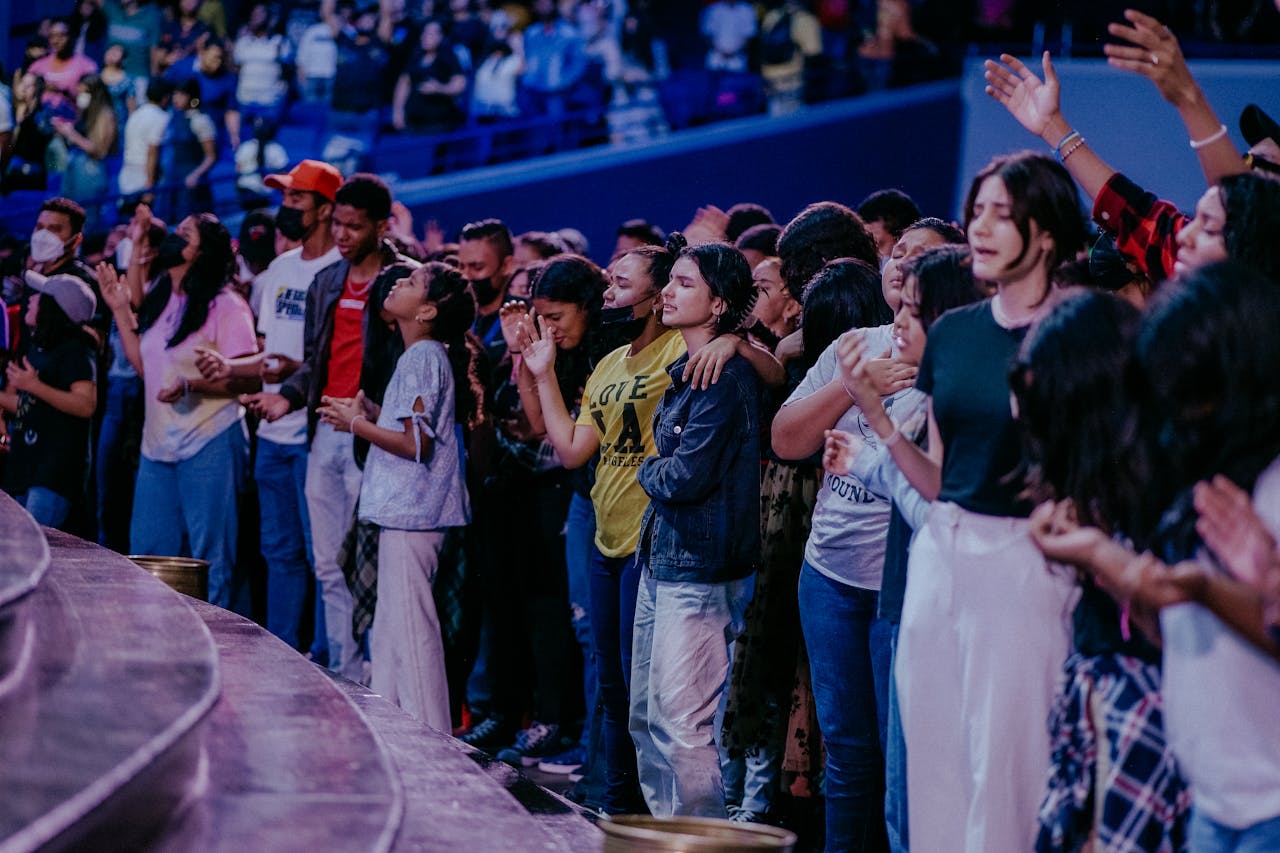
Photo: “Crowd of People Praying” by Luis Quintero, via Pexels. Free to use under the Pexels License.
Leave a Reply