When Prophetic Confidence Sounds Too Certain
How certain is PreTrib Dispensationalism? That question matters because PreTrib Dispensationalism often speaks with remarkable confidence about the end of the age. In moments of war, geopolitical upheaval, and global instability, some prophecy teachers do not merely say that the world is unstable. They say the sequence is already visible: America will step back, Russia will move, Israel will be attacked, the rapture will occur, and the final world ruler will rise. That is a very large claim, and it deserves careful testing.1
In recent weeks, the deepening war involving Iran and the disruption of the Strait of Hormuz have made that confidence even more visible. Some voices have treated these developments not simply as tragic events in a broken world but as signs that the prophetic clock is now striking its final hour.
That is the issue this article seeks to address. The question is not whether Christians should believe in the return of Christ. Of course they should. Nor is the question whether Scripture speaks about judgment, resurrection, tribulation, and the final triumph of God. It certainly does. The real question is whether PreTrib Dispensationalism is as certain as it sounds when it lays out its end-time order with such precision. My answer is no. It is often coherent within its own system, but coherence is not the same thing as certainty. A scheme can fit together neatly and still press texts beyond what they actually say.
A System That Already Knows the Ending
Part of the confidence comes from the system itself. Dispensationalism does not begin with one isolated text. It begins with a structure: history divided into dispensations, a strong distinction between Israel and the church, a largely literal reading of Old Testament promises concerning national Israel, and the expectation that the church will be raptured before Daniel’s seventieth week. Standard summaries of dispensational theology describe exactly these features. Once those foundations are in place, world events no longer arrive as open questions. They arrive as pieces to be inserted into a chart that already exists.2
That is why the system can sound so confident. It does not merely interpret prophecy; it often interprets the present through prophecy already mapped in advance. It knows beforehand that Israel must remain central, that the church must be removed before the tribulation, and that the nations must gather in a final crisis. Then, when war breaks out, many believers trained in that framework do not first ask, “What does this text mean in its context?” They ask, “Where does this passage fit on the chart?” That is a unique question. Once that question governs the reading, uncertainty begins to fade—not because the Bible’s clarity has been found, but because the system has predetermined the type of clarity it anticipates.
The Problem With Reading the Headlines Through Ezekiel
Consider the well-known phrase from Ezekiel 38, which describes God placing hooks in Gog’s jaws. The passage does say that God will draw Gog out for judgment. But the text itself does not say Russia by name. It does not say America must withdraw first. It does not mention oil routes, global energy markets, NATO, or the Strait of Hormuz. Those details do not come from Ezekiel. They come from modern interpreters who apply a comprehensive geopolitical framework to the text and then analyze it through that lens. Once that happens, inference begins to wear the clothes of exegesis.3
This issue matters because the Russia reading itself is much less certain than prophecy teachers often suggest. Many popular teachers take “Rosh” in Ezekiel 38 to be a proper name and identify it with Russia. However, evangelical scholars have long disputed that identification. J. Paul Tanner, writing in the Journal of the Evangelical Theological Society, argued that the Russia connection rests on weak etymology and overreads the “far north” language, concluding that there is “no firm basis” for interpreting Gog as Russia. In other words, the very move that underlies so much confident prophecy preaching is not an agreed-upon fact of biblical scholarship. It is a contested interpretive judgment.4
When Detail Creates the Illusion of Certainty
And this is where the deeper theological issue appears. PreTrib Dispensationalism often promises certainty because it confuses detail with authority. The more elaborate the sequence becomes, the more persuasive it feels. Names of nations are matched. Alliances are projected. Timeframes are proposed. Wars are assigned a place. But detail can create an illusion of certainty. A map with many lines on it feels exact, even when several of those lines were drawn by the interpreter rather than by the text itself. The confidence comes not only from Scripture but also from the habit of stitching Scripture, current events, and inherited prophecy traditions into one seamless story.
Revelation Was Given for Faithfulness, Not Speculation
The irony is that Revelation itself does not invite that kind of overconfidence. It is certainly about the end, but it was not given so Christians could master a newspaper codebook in advance. Revelation does not train the church to decode headlines. It forms the church to remain faithful when the pressure rises.
John introduces himself as a partner in “the tribulation and the kingdom and the patient endurance that are in Jesus” (Rev. 1:9), and that note of endurance runs through the whole book (Rev. 13:10; 14:12). Revelation calls the saints to bear costly witness in the pattern of Jesus, the faithful witness (Rev. 1:5; 12:11).
It also calls them to refuse the seductive pull of idolatry and the false worship demanded by beastly power (Rev. 2:14, 20; 13:15), and to follow the Lamb in loyal obedience wherever he goes (Rev. 14:4; 17:14). Its visions are theological before they are journalistic.
Revelation tears the mask off empire. It exposes Babylon’s splendor as violent and corrupt. And it reminds suffering believers that the Lamb reigns, the martyrs are not forgotten, and the tears of God’s people will not have the last word (Rev. 13:1–8; 17:1–6; 18:1–24; 21:1–4).
Revelation does not hand the church a rigid modern timeline to complete every time the nations go to war.
That is why so much popular prophecy talk can miss the point while claiming to defend it. When Christians use Revelation mainly to identify the next war, the next ruler, the next alliance, or the next stage in geopolitical collapse, they often turn a book meant to sustain faithfulness into a machine for producing speculation. And once speculation becomes a habit, certainty becomes a performance. The teacher must sound sure, because the system depends on sounding sure.
The Moral Danger of Prophetic Overconfidence
But there is more at stake here than tone. There is a moral danger.
The deeper problem with PreTrib Dispensationalism is that it can train Christians to read modern wars, states, and political aggression through an apocalyptic script they already think they understand. Once that happens, they no longer judge violence first by the character of Christ. They judge events based on whether they seem to move history closer to their prophetic expectations. That is a terrible distortion. Christians are not called to greet war with prophetic excitement. They are called to grieve bloodshed, tell the truth about aggression, defend the dignity of the vulnerable, and refuse to baptize the ambitions of empire.
This is where the system can become spiritually dangerous even when many of its adherents are sincere and devout. It can make believers strangely tolerant of state violence when that violence appears to serve the prophetic timetable they expect. Regional chaos can start to look necessary. Civilian suffering can begin to look like the cost of fulfillment. People may perceive a crisis in the Middle East not initially as a human tragedy but rather as a positive indication that “things are moving.” That is not Christian wisdom. That is moral numbness hiding inside religious excitement. The recent reporting on prophecy-minded Christian responses to the Iran war shows exactly this tendency: some leaders framed the war not mainly as a grief to lament but as confirmation that history is moving on cue.5
No Eschatology Has the Right to Dull Christian Moral Vision
The church must resist that with all its strength. Eschatology must never dull Christians’ moral vision. Prophetic charts must not make cruelty look sacred. And end-time schemes must never turn human suffering into a stepping stone for theological satisfaction. Jesus did not teach his followers to greet injustice with prophetic excitement. When he spoke of wars and turmoil, he called them to endurance, not celebration (Matt. 24:6–13; Luke 21:9, 19). And in the midst of a violent world, he formed them for mercy, truthfulness, peacemaking, and costly love (Matt. 5:7, 9, 37, 44; John 15:13; 18:11).
This passage does not mean Christians must become vague about the future. The New Testament is not vague about the final victory of God. Christ will return (Acts 1:11; 1 Thess. 4:16), and evil will not win, for every hostile power — even death itself — will be brought down before him (1 Cor. 15:24–26; Rev. 20:10).
The dead will be raised (John 5:28–29; 1 Cor. 15:52), judgment will come (Acts 17:31; 2 Cor. 5:10), and new creation will be God’s final answer to death, decay, and sorrow (Rom. 8:19–23; Rev. 21:1–4). On these certainties, the church may stand with full confidence.
But that is very different from claiming, with the same certainty, that Gog is Russia, that a current war is the trigger, that a specific withdrawal fulfills the hook in the jaw, or that we are days away from the seven-year tribulation. Those claims go beyond what the texts themselves warrant.
So How Certain Is PreTrib Dispensationalism?
Perhaps it is certain enough to function as a modern system, persuading millions and generating books, charts, conferences, and viral posts. But it is not certain enough to claim that its detailed sequence is simply what the Bible plainly says. It is not certain enough to silence other readings within the wider Christian tradition. And it is certainly not certain enough to let Christians speak as though present wars are already interpreted by their prophetic scheme.
Reading the World Through the Cross
In the end, the problem is not only exegetical. It is pastoral and political. A church addicted to prophetic certainty can become unable to read the world through the cross. Such a church may begin to admire strength more than faithfulness. It may scan the horizon for signs while forgetting to love its neighbor. And it may speak of Israel, Iran, Russia, and Antichrist with immense urgency while saying almost nothing about peacemaking, repentance, justice, or the tears of the innocent.
Christ calls the church neither to cynical unbelief nor to feverish chart-making. Jesus warns his followers not to seize what the Father has kept in his own authority (Acts 1:6–7) and reminds them that they do not know the day or hour (Matt. 24:36). Instead, Christ calls them to watchfulness without arrogance.(Matt. 24:42; Rom. 12:3), hope without speculation (Titus 2:13; 1 Pet. 1:13), courage without triumphalism (John 16:33; Rom. 12:21), and expectation without moral blindness (Luke 21:34–36; Matt. 25:31–46). Scripture does not tell us enough to make us smug. It tells us enough to make us faithful (Matt. 24:45–46; Rev. 13:10; 14:12).
Certainty Belongs in Christ, Not in Our Charts
In the end, certainty belongs not to our prophetic timelines but to Jesus Christ himself. He is the fixed center of biblical eschatology: the crucified and risen Lord who will judge the nations in righteousness (Acts 17:31), bring down every hostile power (1 Cor. 15:24–25; Rev. 13; 18), vindicate the saints who have suffered for his name (Rev. 6:9–11; 7:14–17), and make all things new (Rom. 8:19–23; Rev. 21:1–5). Any eschatology, therefore, that makes Christians less like Christ — less truthful, less merciful, less sober, less committed to peace — has gained a false confidence at the cost of real faithfulness (Matt. 5:7–9, 44; Eph. 4:15, 25; James 3:17–18).
The church doesn’t need an eschatology that makes it more excited about war. It needs an eschatology that makes it more faithful to the Lamb.
Footnotes
- Religion News Service / The Conversation, “As Iran war expands, some conservative Christians interpret the conflict through biblical prophecies,” March 16, 2026; Reuters reporting on Trump’s Iran comments and the Strait of Hormuz. ↩︎
- Encyclopaedia Britannica, “Dispensationalism”; Michael J. Vlach, “Dispensational Theology,” The Gospel Coalition. ↩︎
- Ezekiel 38:1–4 and popular prophecy readings that connect Gog’s “hooks” to modern geopolitical triggers. ↩︎
- J. Paul Tanner, “Rethinking Ezekiel’s Invasion by Gog,” Journal of the Evangelical Theological Society 39, no. 1 (1996): 29–46. ↩︎
- Religion News Service / The Conversation, “As Iran war expands, some conservative Christians interpret the conflict through biblical prophecies,” March 16, 2026. ↩︎
Image Attribution
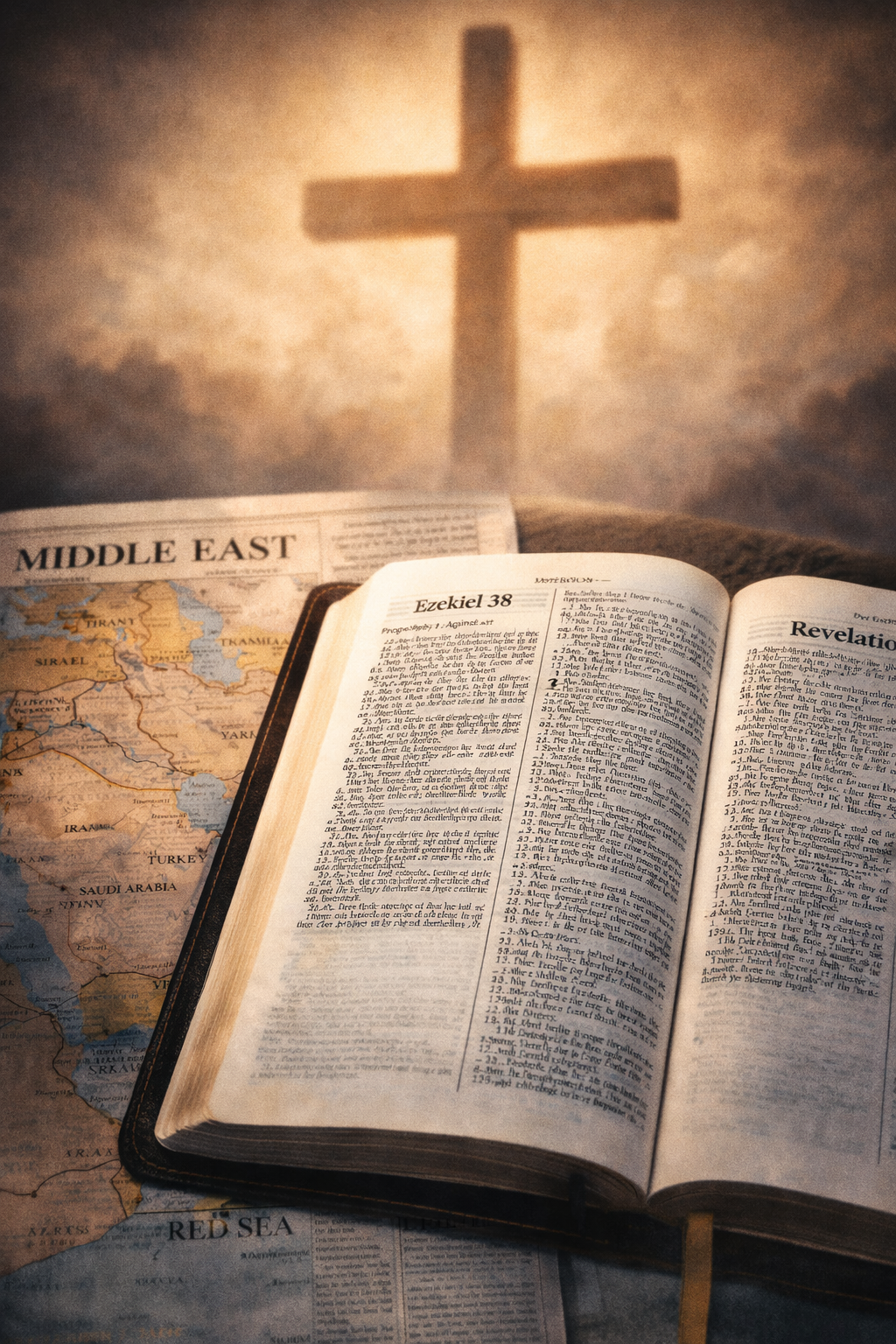
AI-generated image created from the author’s prompt for this article. The concept depicts an open Bible with Ezekiel 38 and Revelation beside a newspaper map of the Middle East, with a larger cross in the background to emphasize that Christian certainty belongs finally in Christ rather than in prophetic charts.
Leave a Reply