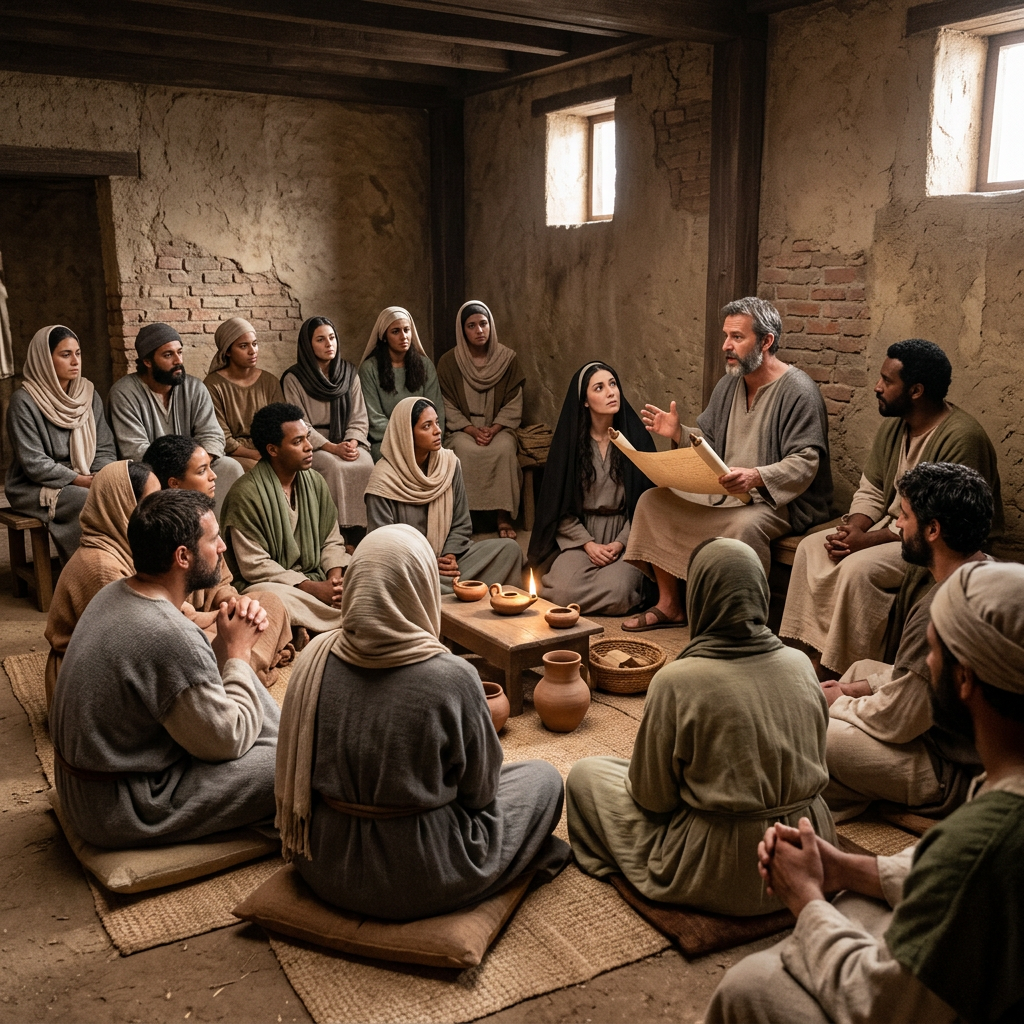
Women’s Ordination, Mutual Submission, and the Gospel of Christ
For generations, Christians have debated whether women should be ordained to preach, teach, and exercise pastoral leadership in the Church. Some regard the ordination of women as a departure from biblical authority. Others see it as a faithful recognition of the gifts God has already bestowed upon His people. Both appeal to Scripture, and both claim to honor the lordship of Jesus Christ.
Yet perhaps we have been asking the question from the wrong direction. Before asking whether women may exercise authority over men, we should ask what kind of authority Jesus intended His Church to exercise in the first place. Before treating male headship as a settled principle, we should examine how Paul describes relationships among those who belong to Christ. And before excluding women from ministry, we must account for the women whom the New Testament itself recognizes as significant participants in the mission of the gospel.
The question of women’s ordination is therefore not simply about gender. It concerns our understanding of Scripture, the work of the Holy Spirit, the character of Christian authority, and the kind of community God is creating through the Messiah.
Mutual Submission Comes Before the Household Instructions
One of the most important passages in this discussion is Ephesians 5:21, where Paul calls believers to submit to one another out of reverence for Christ. The instruction belongs to his larger exhortation to be filled with the Spirit (Ephesians 5:18). Worship, thanksgiving, and mutual submission describe the life of a community shaped by God’s presence.
Only after establishing this broader framework does Paul address wives and husbands. An important textual detail deserves attention. In a number of significant early Greek witnesses, Ephesians 5:22 does not contain a separate verb meaning “submit.” The instruction to wives takes its verbal sense from verse 21. Other manuscripts contain an explicit verb, and scholars continue to debate the textual evidence. Nevertheless, the literary connection between the two verses remains important.
Paul does not introduce marriage as a relationship exempt from the Christian obligation of mutual submission. He addresses it within a discussion of Spirit-filled life. When he turns to husbands, he does not command them to assert their authority. Instead, he instructs them to love their wives as Christ loved the Church and gave Himself for her.
We should acknowledge that Paul does not give husbands and wives identical instructions. Nor does Ephesians 5:21, by itself, settle every disagreement about marriage. Complementarian interpreters maintain that mutual submission can coexist with differentiated responsibilities. Egalitarian interpreters understand it as a principle that transforms inherited hierarchies more fundamentally. Yet neither reading should overlook Paul’s central ethical demand: the husband’s relationship with his wife must reflect Christ’s self-giving love, not the pursuit of personal privilege.
This becomes clearer when we turn to 1 Corinthians 11:11–12. After discussing the relationship between man and woman through the language of creation, Paul declares that, in the Lord, neither exists independently of the other. Woman came from man, but man now comes through woman, and everything ultimately comes from God.
Whatever Paul intends by the word head (kephalē) earlier in that chapter, his concluding emphasis is unmistakable. Men and women stand in mutual dependence before their Creator. Neither can claim an independent superiority over the other.
The Women Paul Actually Recognized
When discussing women’s ordination, Christians frequently begin with the passages that appear to restrict women’s teaching. Those texts deserve serious examination. But they are not the only relevant evidence, and they should not determine our reading of every other passage before the investigation has even begun.
Consider Phoebe in Romans 16:1–2. Paul commends her as a diakonos of the church at Cenchreae and describes her as a prostatis, a term associated with patronage and assistance. The precise relationship between her ministry and the later office of deacon remains debated. Nevertheless, Paul does not present Phoebe as an incidental helper. He recognizes her as a significant participant in the Church’s work and asks the Roman believers to receive and assist her.
Then there is Junia, whom Paul greets alongside Andronicus in Romans 16:7. The passage describes them using an expression that many scholars understand as meaning they were outstanding among the apostles. Others interpret it as meaning that they were well known to the apostles. The disagreement is genuine, but Junia’s place among Paul’s honored fellow workers should not be minimized simply because the question of her apostolic status remains debated.
Acts 18 introduces Priscilla, who, together with Aquila, explains the way of God more accurately to Apollos, an educated and eloquent teacher. The account does not describe a formal act of ordination, nor does it take place as an instruction to a gathered congregation. Yet it plainly portrays a woman participating in the theological instruction of a man already active in ministry.
Meanwhile, 1 Corinthians 11:5 assumes that women pray and prophesy. Paul regulates the manner of their participation, but he does not deny that they participate. Prophecy, according to 1 Corinthians 14:3, serves to strengthen, encourage, and console the community. It is hardly an insignificant expression of spiritual activity.
These women do not establish a complete New Testament blueprint for modern ordination. The Church’s subsequent structures of ministry developed over time. But their presence makes one conclusion difficult to sustain: that God categorically excludes women from meaningful teaching, proclamation, and leadership simply because they are women.
If Scripture recognizes women through whom God was already working, the Church must take that evidence seriously.
What About Paul’s Prohibition in 1 Timothy?
A responsible argument for women’s ordination cannot avoid 1 Timothy 2:11–15. The passage restricts a woman’s teaching and exercise of authority in relation to a man, then appeals to Adam and Eve. It is among the strongest texts cited by those who oppose the ordination of women.
The historical setting deserves attention. First Timothy repeatedly expresses concern about false teaching, speculation, and disorder within the believing community. Some interpreters therefore understand the restriction as a response to a particular problem in Ephesus. Others argue that the appeal to creation establishes a principle intended for all churches.
The Greek verb authentein, often translated “to exercise authority,” adds another difficulty. It occurs only here in the New Testament. Scholars disagree about whether it denotes authority in a relatively neutral sense or carries a more negative implication of domineering or improperly assuming control. The context must help determine its meaning.
Neither side should pretend that these questions are simple. The appeal to Adam and Eve is especially important for those who understand the instruction as universal. Yet an appeal to creation does not automatically remove a passage from its historical circumstances. Paul also employs creation arguments when discussing head coverings in 1 Corinthians 11, a passage whose practical application Christians have interpreted differently across cultures and centuries.
We must also consider 1 Corinthians 14:34–35, which instructs women to remain silent in the churches. Its relationship to Paul’s earlier recognition of women praying and prophesying has long generated discussion. Some scholars understand the instruction as addressing a particular kind of disruptive speech. Others debate the textual history of these verses. Whatever conclusion one reaches, the apparent tension must be examined rather than ignored.
I do not believe these restrictive passages can responsibly be dismissed as though Paul never wrote them. But neither should they be isolated from the substantial evidence of women’s participation in the earliest Christian communities. The task of interpretation is to understand how these texts belong together within the larger biblical witness.
The question is not whether we should obey Scripture. It is whether our interpretation has adequately accounted for all that Scripture says.
The Trinity Is Not a Blueprint for Male Supremacy
A recent discussion by Anglican theologian Peter Carnley adds another dimension to this debate. In his 2026 article, Not Celebrating the Installation of Dame Sarah?, Carnley challenges several arguments used to oppose women’s ordination, including the claim that the Son’s eternal subordination to the Father provides a divine pattern for male authority over women.
The issue reaches into the heart of Christian doctrine.
The New Testament describes Jesus as obedient to the Father in His earthly mission. Philippians 2:5–11 celebrates His self-giving humility, while the Gospels portray His willing obedience even unto death. Yet this obedience must be understood in relation to the Incarnation. The eternal Son truly assumed our humanity and fulfilled the Father’s saving purpose as the incarnate Messiah.
Classical Nicene theology confesses the Son as fully divine, sharing the one divine being, power, and glory of the Father and the Spirit. The divine persons are genuinely distinct, but their distinction should not be reduced to a hierarchy of superior and inferior authority. The historic doctrine of the Trinity does not require us to imagine three independent divine wills arranged within a chain of command.
Consequently, we should be cautious about projecting the Son’s obedience in His earthly ministry backward into eternity and then using that supposed arrangement to establish permanent authority for men over women.
This does not mean that every Christian who opposes women’s ordination embraces eternal subordination within the Trinity. Many do not. Nor does rejecting that theological argument automatically settle the interpretation of 1 Timothy 2. Carnley’s criticism, however, exposes a serious danger: we must not reshape our doctrine of God merely to justify an inherited pattern of human authority.
The Trinity reveals God’s eternal life. It must not become a convenient explanation for why some Christians should always rule over others.
In Christ, a New Family Has Come into Being
Galatians 3:28 belongs at the center of this discussion, although it must be interpreted carefully. Paul declares that in Christ there is no longer Jew or Greek, slave or free, male and female, for believers are all one in Him.
Within the argument of Galatians, this declaration concerns belonging to the family promised to Abraham. Gentiles do not need circumcision or observance of the Mosaic Law as a condition of membership in God’s covenant people. Through the faithfulness of the Messiah, those who belong to Christ share in Abraham’s promised inheritance.
Paul is not claiming that all human differences have disappeared. Men and women remain embodied persons with their particular identities. Nor does Galatians 3:28 explicitly prescribe a structure for ordained ministry.
Nevertheless, the declaration is far more than a statement about equal spiritual worth detached from the actual life of the Church. The gospel creates one covenant family in which inherited distinctions no longer determine who belongs to Christ.
This has consequences for fellowship, dignity, participation, and the exercise of spiritual gifts. We cannot affirm equal belonging in Christ while refusing even to examine whether our institutional arrangements reflect that new reality.
Furthermore, Paul’s description of the Church as Christ’s body in 1 Corinthians 12 shifts attention away from inherited social status toward the gifts distributed by the Spirit. The members differ, but their diversity exists for the common good. No member possesses independent superiority, and those who appear less important receive particular honor.
The purpose of ministry is not to protect the privileges of a few. It is to build up the entire body toward maturity in Christ.
Authority in the Church Must Look Like Jesus
Perhaps the most searching passage in this debate is Mark 10:42–45. Jesus acknowledges that the rulers of the nations exercise authority over others. He then tells His disciples that greatness among them must take a different form.
Whoever desires greatness must become a servant, and whoever wishes to be first must become the servant of all. Jesus Himself establishes the pattern, for the Son of Man came not to be served but to serve and give His life as a ransom for many.
This does not abolish leadership or make every distinction of responsibility meaningless. But it transforms the character of authority. Christian leaders do not receive authority as a possession that elevates them above the community. They receive responsibility for the welfare and maturity of others. Their calling must always reflect servant-shaped Christian authority rather than the preservation of institutional privilege.
Here we arrive at the decisive question concerning women’s ordination. If a woman faithfully teaches Scripture, exhibits the fruit of the Spirit, demonstrates wisdom and pastoral maturity, and receives recognition of her gifts from the Christian community, on what grounds must the Church refuse to acknowledge her calling?
The answer cannot simply be that women have always been excluded. Historical continuity deserves respect, but longevity alone does not establish biblical authority. Nor can the answer rest upon an imagined hierarchy within the Trinity.
Those who believe Scripture permanently reserves particular offices for men must make that case through careful exegesis and a coherent theology of ministry. Those who support women’s ordination must likewise demonstrate that their position arises from Scripture rather than merely from contemporary cultural expectations.
For my part, I find the cumulative New Testament witness more persuasive in favor of recognizing qualified women for ordained ministry. This conclusion does not rest upon one disputed Greek word or the claim that every early Christian ministry was identical to a modern pastoral office. It arises from the combined testimony of women’s actual ministries, the Spirit’s distribution of gifts, mutual submission, the equality of covenant belonging, and the servant-shaped authority of Jesus Christ.
A Church Faithful to the Gifts of the Spirit
The question of women’s ordination should never become a contest in which men and women struggle for possession of ecclesiastical power. If ordination is understood primarily as gaining authority over others, then the Church has already misunderstood the nature of Christian ministry.
Ordination should recognize calling, character, competence, and responsibility before God and the community. The Church must examine those who seek leadership, whether male or female, and hold them accountable to the teaching and example of Christ. No appeal to spiritual gifting excuses an absence of integrity, and no claim of institutional authority removes the obligation to serve.
Christians who disagree about women’s ordination should continue to engage one another with theological seriousness and mutual respect. The matter involves difficult texts and longstanding ecclesial traditions. Yet respect for those disagreements must not prevent us from asking whether inherited restrictions have sometimes obscured the gifts God has placed among His people.
The Church belongs to Jesus Christ. Its ministries exist for His purposes, not for the preservation of human privilege. If the risen Lord gives His Spirit to sons and daughters, as Peter announces in Acts 2:17–18, the Church must listen carefully before deciding whose voices may be heard.
Perhaps the question is not whether women should be permitted to possess authority over men. Perhaps the deeper question is whether the Church is willing to recognize those whom the Spirit has equipped to serve.
For when God calls someone to the work of His kingdom, our responsibility is not to defend an inherited hierarchy at all costs. It is to discern that calling faithfully, test it responsibly, and receive the gifts through which Christ continues to build up His body.
The Church should never confuse faithfulness to Scripture with faithfulness to a restriction that Scripture itself may not require.
References
- 1. Peter Carnley, “Not Celebrating the Installation of Dame Sarah?” Journal of Anglican Studies (2026). DOI: 10.1017/S1740355326101405. His published abstract identifies the arguments concerning Scripture, creation, Trinitarian subordination, and ordination. The full article was not available for this draft. Cambridge Core Cambridge Core article
- 2. Linda Belleville, “Ιουνιαν … επισημοι εν τοις αποστολοις: A Re-examination of Romans 16.7 in Light of Primary Source Materials.” New Testament Studies 51, no. 2 (2005): 231–249. A defense of understanding Junia as notable among the apostles. Cambridge Core Read abstract
- 3. Michael H. Burer and Daniel B. Wallace, “Was Junia Really an Apostle? A Re-examination of Rom 16.7.” New Testament Studies 47, no. 1 (2001): 76–91. An alternative reading of Junia’s relationship to the apostles. Including both studies demonstrates the existence of a real scholarly debate. Cambridge Core Read abstract
Leave a Reply