trinity
-

The Trinity did not arise from a mathematical formula. It grew from the church’s attempt to remain faithful to Israel’s confession of one God while recognizing Jesus within the divine identity and the Spirit as God’s personal presence.
-

Jesus Christ is not one doctrine among many. Christ-centered theology gives every biblical truth its proper unity while calling the church back to humility, love, and faithful discipleship.
-
Hebrews says God spoke through the prophets, while Jesus says no one had heard the Father’s voice. Is this a contradiction? Read these texts through the biblical revelation of the Father, Son, and Holy Spirit.
-
Some Christians use Matthew 6:6 to argue that the Father is hidden, inaccessible, and therefore should not be addressed in prayer. But the very passage they cite says the opposite. Jesus does not forbid prayer to the Father. He commands it.
-

True devotion to Jesus does not silence the Father or reduce the Spirit. The gospel brings us to the Father, through the Son, in the Spirit. Christ is our High Priest, not to keep us away from God, but to bring us near.
-

The Trinity is not a mathematical puzzle or a competition within God. It is the Christian confession that the one God of Israel has made himself known as Father, Son, and Spirit.
-

Some Christians claim that all prayer must be addressed only to Jesus, and that praying to the Father is sinful. But Jesus himself taught his disciples to pray, “Our Father.” The New Testament gives us a richer pattern: to the Father, through the Son, in the Spirit.
-
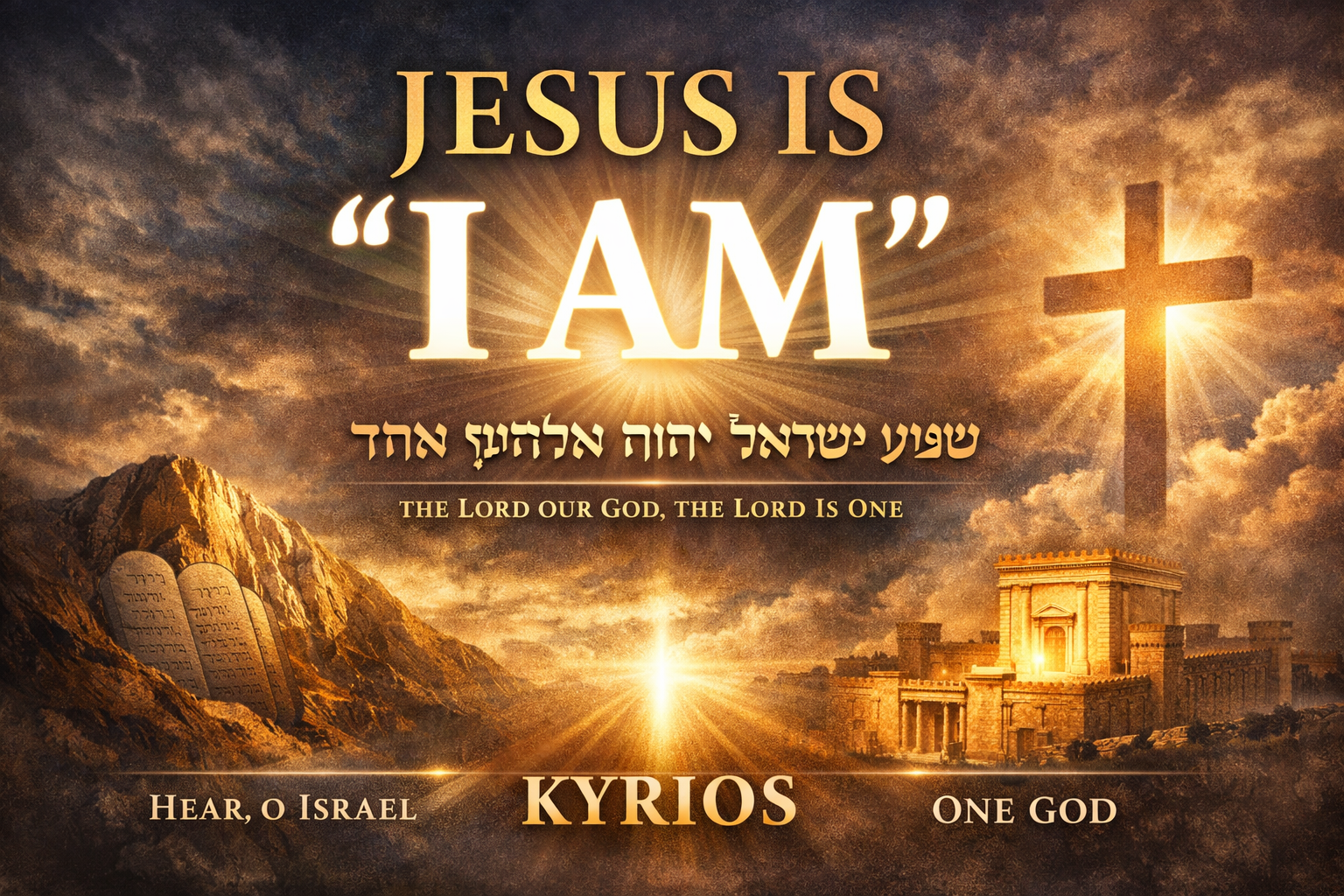
Confessing Jesus as “I AM” did not lead early Christians away from Jewish monotheism—it reshaped it. This post explores how the Shema, kyrios, and Second Temple Jewish thought help us understand how Jesus is included within the divine identity without collapsing Father, Son, and Spirit.
-

Christian faith exalts Jesus as Lord, yet Scripture teaches us to honor him within the Father–Son–Spirit pattern. Christ reveals the Father (John 14:9), brings us to the Father (Heb 2:10), and gives the Spirit who makes us cry “Abba” (Rom 8:15). True Christology follows this triune story.