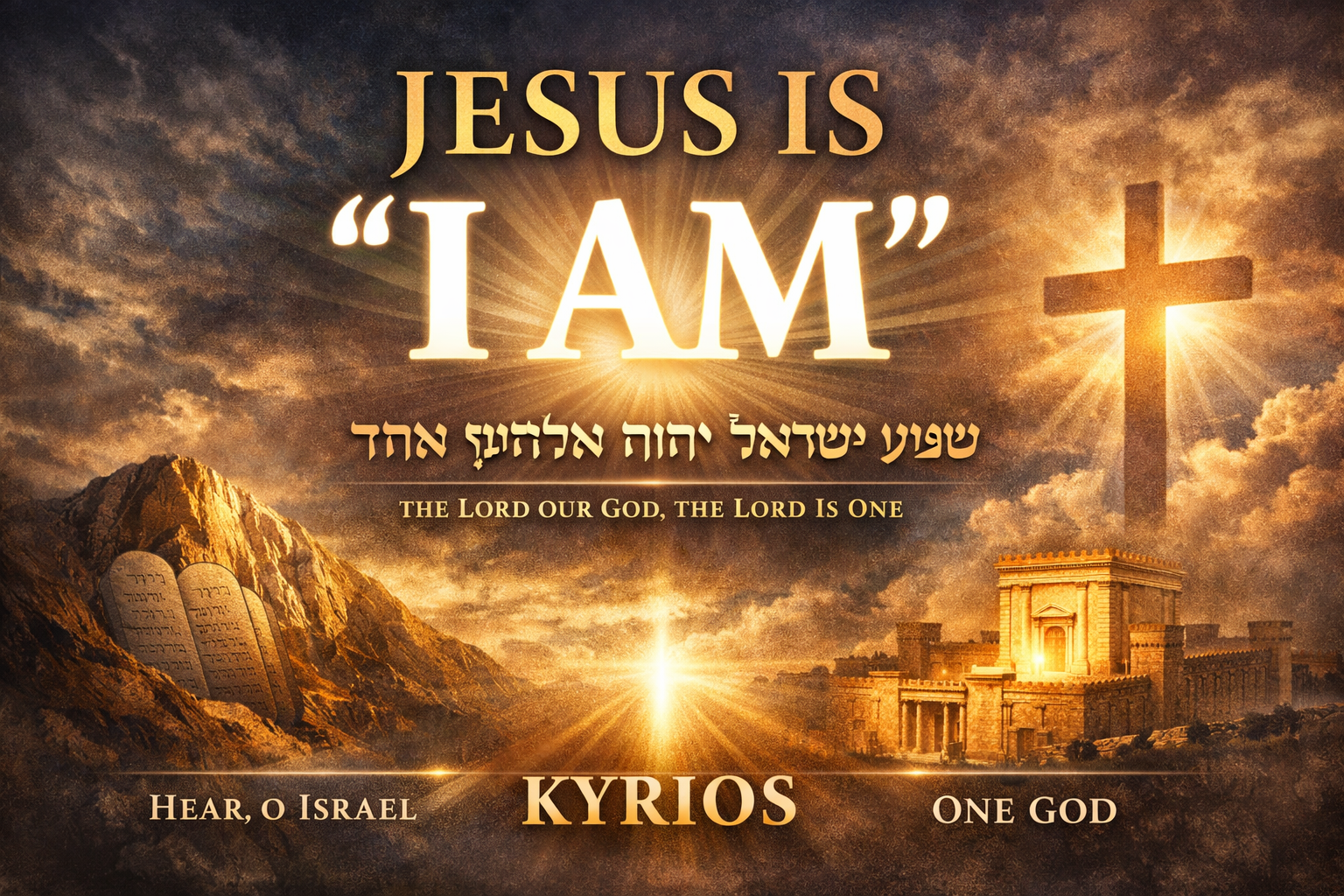
A Second Temple Jewish Clarification
I recently encountered a theological claim asserting that Jesus, the Son, is exclusively the “I AM THAT I AM,” the LORD who spoke to Moses, and that among the Triune God only the Son directly speaks God’s words to the world. The impulse behind such claims is understandable and, in an important sense, right: the New Testament unmistakably identifies Jesus with the God of Israel. The early Christian confession that “Jesus is Lord” is not a downgrade of Israel’s monotheism but a bold restatement of it.
Yet how this identification works—and what it does not mean—requires careful attention to the Jewish and scriptural world in which these claims first made sense.
The Shema and Jewish Monotheism
At the heart of Israel’s faith stands the Shema:
“Hear, O Israel: the LORD our God, the LORD is one” (Deut 6:4).
This confession functioned not primarily as a philosophical statement about numerical oneness, but as a declaration of exclusive allegiance and divine identity—YHWH alone is Creator, covenant Lord, and worthy of worship.¹ Second Temple Jews guarded this confession fiercely, even while developing rich ways of speaking about God’s Word, Wisdom, Spirit, and Glory.
Crucially, Jewish monotheism already allowed for complexity without division. God could act through His Word, reveal Himself through His Wisdom, and be present by His Spirit—without ceasing to be one.²
“I AM” and the Divine Name
When Jesus declares, “Before Abraham was, I am” (John 8:58), the echo of Exodus 3:14 is deliberate. The claim is startling precisely because it places Jesus within the identity of Israel’s God. In Jewish Scripture, the “I AM” is not a metaphysical abstraction but a covenantal self-identification: the God who will be faithful to His promises and present with His people.³
Yet John does not present Jesus as replacing the Father or exhausting the identity of YHWH. Throughout the Gospel, Jesus speaks of being sent, of doing the Father’s will, of receiving authority, and of acting in the power of the Spirit (John 5:19; 12:49). The divine name is not monopolized by the Son; it is revealed through him.⁴
Kyrios and the Reworking of the Shema
The Greek term kyrios is decisive here. In the Septuagint, kyrios regularly renders the divine name YHWH. When early Christians confessed “Jesus is Lord” (Rom 10:9; Phil 2:11), they were not granting Jesus a secondary honor beneath God. They were including him within the unique divine identity confessed in Israel’s Scriptures.⁵
Paul’s reworking of the Shema in 1 Corinthians 8:6 is especially instructive:
“For us there is one God, the Father… and one Lord, Jesus Christ…”
Paul does not abandon monotheism. He reconfigures its grammar, distributing the language of the Shema between Father and Son while maintaining the oneness of God. Creation, sovereignty, and worship belong to both—yet Father and Son remain distinct.⁶
Divine Identity, Not Divine Replacement
This is where some modern formulations become theologically strained. To say that Jesus is included in the divine identity is not to say that he is the only bearer of that identity. The New Testament consistently portrays Father, Son, and Spirit as inseparably active.
The Father speaks (Matt 3:17).
The Spirit speaks (Acts 13:2).
The Son speaks—but not independently (John 5:19).
Jesus does not claim to be the Father, nor does he suggest that the Father has ceased to act or speak. His authority is fully divine, yet it is also received—a gift bestowed in accordance with God’s saving purpose (Acts 2:36; Phil 2:9).⁷
Worship, Allegiance, and the Crucified Lord
In Second Temple Judaism, worship is the clearest marker of divine identity. Prayer, invocation, and cultic devotion belong to God alone. The fact that Jesus receives worship, prayer, and the invocation of the divine name indicates that he is included within God’s unique identity—not as a rival deity, but as the crucified and risen Messiah through whom Israel’s God now reigns.⁸
This confession is not speculative but doxological. To say “Jesus is Lord” is to give him the allegiance, trust, and obedience that Israel owed to YHWH alone—and to do so to the glory of God the Father (Phil 2:11).
One God, Newly Revealed
The New Testament does not resolve the mystery of God by collapsing everything into a single divine speaker. It deepens Israel’s confession by revealing the one God as Father, Son, and Spirit—distinct yet united, relational yet one.⁹
The question, then, is not whether Jesus can be identified with the “I AM.” The New Testament answers that with a resounding yes. The deeper question is how that identification reshapes our understanding of God. And Scripture’s answer is not simplification, but communion:
one God, now known through the obedient Son, in the power of the Spirit, to the glory of the Father.
Footnotes
- Richard Bauckham, Jesus and the God of Israel (Grand Rapids: Eerdmans, 2008), 95–123; James D. G. Dunn, The Theology of Paul the Apostle (Grand Rapids: Eerdmans, 1998), 258–262.
- Proverbs 8:22–31; Sirach 24; Wisdom of Solomon 7–9; John J. Collins, Jewish Wisdom in the Hellenistic Age (Louisville: Westminster John Knox, 1997), 45–78.
- Brevard S. Childs, The Book of Exodus (Philadelphia: Westminster, 1974), 75–82.
- Craig R. Koester, The Word of Life: A Theology of John’s Gospel (Grand Rapids: Eerdmans, 2008), 102–108.
- Gordon D. Fee, Pauline Christology (Peabody: Hendrickson, 2007), 202–210.
- Richard Bauckham, Jesus and the God of Israel, 182–232; N. T. Wright, Paul and the Faithfulness of God (Minneapolis: Fortress, 2013), 655–660.
- Acts 2:36; Philippians 2:9; James D. G. Dunn, Christology in the Making (Grand Rapids: Eerdmans, 1989), 239–245.
- Larry Hurtado, One God, One Lord (Edinburgh: T&T Clark, 1988), 99–123; Revelation 5:8–14.
- Matthew 28:19; John 5:19–23.
𝘛𝘩𝘪𝘴 𝘱𝘰𝘴𝘵 𝘮𝘢𝘺 𝘣𝘦 𝘴𝘩𝘢𝘳𝘦𝘥 𝘰𝘳 𝘲𝘶𝘰𝘵𝘦𝘥 𝘸𝘪𝘵𝘩 𝘤𝘳𝘦𝘥𝘪𝘵.
Leave a Reply