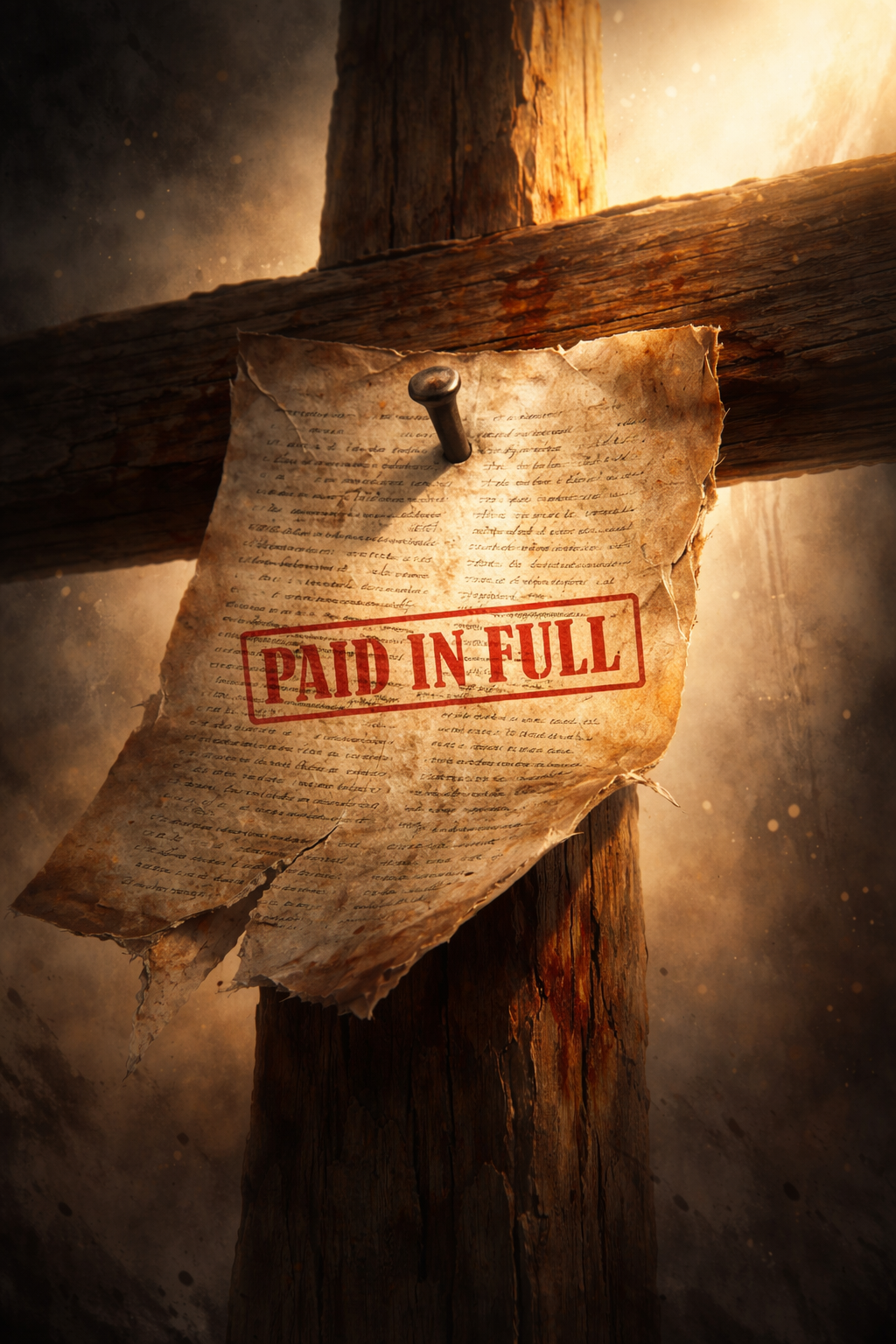
Many Christians believe that the gospel is absolutely free, yet they still live as though they must keep paying God back. They believe Christ has helped but not fully settled the matter. Colossians 2:13–15 says otherwise. Paul declares that God has forgiven all our trespasses, canceled the record of debt that stood against us, and nailed it to the cross. This means that the Christian life does not begin with partial relief and continue through religious installment payments. It begins with the finished work of Christ.
In Colossians 2:13–15, he says that God made us alive with Christ, forgave all our trespasses, canceled the record of debt that stood against us, and nailed it to the cross. This is not the language of partial help, probationary grace, or a salvation in which God covers the first part and leaves the rest for us to manage. It is the language of decisive rescue. God does not save us in installments.1
The Problem Was Never Small
One reason many Christians struggle to believe this is that they quietly reduce the problem. They treat sin as if it were mainly weakness, immaturity, or a bad habit. But Paul speaks more sharply than that. He asserts that our trespasses have rendered us dead. Dead people do not need coaching. Dead people do not need some inspiration. They need resurrection.
And Paul also says there was a “record of debt” standing against us. That image matters. He is not describing vague religious guilt. He is describing real liability before the holy God. Human beings are not simply confused. We are rebels who have twisted worship, damaged one another, and stood under accusation. That is why the gospel cannot be good advice. Advice cannot erase guilt. Religious effort cannot remove an indictment. Moral improvement cannot tear up the document that stands against us.2
This is where so much anxious religion goes wrong. It tells people to try harder, do better, pray longer, serve more, contribute more, and strive more. But none of those things can cancel what Paul says stood against us. At best, they are ways of coping with fear. At worst, they become a way of hiding from the truth. If the problem is real guilt before God, then only God can solve it. And in Christ, Paul says, God has done exactly that.
What Was the “Record of Debt”?
In Colossians 2:14, Paul speaks of a “record of debt” that stood against us. He is not describing a vague feeling of guilt, but a real charge hanging over sinful humanity before the holy God. Sin is not merely weakness or poor judgment. It leaves us liable, exposed, and unable to clear our own account. But Paul’s point is glorious: God did not simply ignore that debt. In Christ, He canceled it. He took away the accusation and nailed it to the cross. That means believers do not live before God as people still trying to reduce a remaining balance. The case has been dealt with in the crucified Messiah. The cross was not a partial payment. It was God’s decisive act of forgiveness and release.
The Cross Did Not Start the Process. It Finished the Case.
Paul does not say the cross made forgiveness possible in a vague, unfinished sense. He says God canceled the record of debt, took it away, and nailed it to the cross. That is courtroom language, covenant language, and victory language all at once. It means that the accusation did not survive Calvary.
This is why forgiveness is not God pretending evil does not matter. It is not divine softness. It is not God waving away justice because He has decided to lower the standard. The cross says the opposite. Sin matters so deeply that God deals with it fully. The charge is acknowledged. It is answered. The debt is not postponed. It is canceled. The case is not left open in heaven’s court. It is dealt with in the crucified Messiah.3
That is why Christians must stop speaking as though Jesus only got salvation started. He did not offer forgiveness as a down payment and then expect monthly dues. He did not simply open the way and leave you to finish the challenging part. Christ did not take away only part of your guilt and leave the rest to be worked off through tears, effort, or religious performance. God does not save us in installments. At the cross, He acts decisively and publicly for His people.
“All” Means All
One of the most beautiful words in the passage is the simplest one. Paul says God forgave “all” our trespasses.
That little word destroys a great deal of bad religion.
Many believers say they trust grace, but in practice they live as though forgiveness has limits. They assume Christ covers the dramatic sins, but not the repeated ones. Forgiveness is often imagined to apply to life before conversion, but not to the humiliating failures that follow. Even hidden sins—the ones that keep resurfacing—can seem to fall outside the full reach of grace. So they live with God as though they are always one failure away from being sent back into debt.
But Paul does not say “many.” He does not say “most.” He says “all.”
That does not make sin small. It makes Christ sufficient. It means the Christian stands before God not as a debtor trying to reduce the balance, but as one whose whole case has been taken up by Another. This is why Paul can say elsewhere, “There is therefore now no condemnation for those who are in Christ Jesus” (Rom. 8:1). Not less condemnation. No condemnation.4
The church needs to recover from the shock of that. The gospel does not promise acceptance to sinners on the basis of their spiritual performance.The gospel is that in the Messiah, God has done what sinners could never do for themselves. In Christ, God fully forgives, cancels the charge, and brings the guilty into life.
The Powers Lose Their Main Weapon
Paul does not stop with forgiveness. He says that at the cross God disarmed the rulers and authorities and made a public spectacle of them. In other words, the cross was not only the place where God dealt with private guilt; it was also the place where He stripped the dark powers of their claim.
That matters because accusation is one of evil’s oldest weapons. Shame says, “You still belong to your past.” Fear asserts that your past mistakes hold the ultimate authority. Condemnation says, “You may speak of grace, but the case against you is still open.” Paul says the cross has shattered that whole regime.
The powers do not lose because human beings finally become strong. They lose because Christ has taken away their chief weapon. Once the debt is canceled, accusation no longer carries legal force. Because forgiveness is complete, condemnation cannot claim final authority. And because God has made us alive with Christ, the old tyrants no longer own us.5
This is one reason false religion is so dangerous. It tries to rebuild the prison Christ has already broken open. It keeps Christians spiritually anxious—never quite sure, always apologizing, and always trying to settle what the gospel says Christ has already settled. But the church does not honor Christ by acting as if His victory still needs supplementing.
Holy Living Begins Where the Ledger Ends
Some people hear “strong grace” and worry it will weaken holiness. But Paul moves in the opposite direction. Only forgiven people can finally begin to obey in freedom.
People who think they are still paying off their guilt do not usually become holy. Instead, they become exhausted, defensive, proud, or despairing. They begin to hide failure because they assume it threatens their standing. They begin comparing themselves with others to reassure themselves that they are making progress. Overall, even obedience can turn into bargaining. But none of that is the life of the Spirit.
Real holiness begins when Christians stop relating to God as frightened debtors. It begins when they know that Christ has already dealt with the case against them. Obedience begins to flow from gratitude instead of panic. Confession becomes honest rather than theatrical. Prayer is no longer damage control, but fellowship with God. Love for one’s neighbor becomes possible because we no longer live trapped in endless spiritual self-justification.
This is the freedom Paul is protecting in Colossians. Christ is not one layer in a larger religious system. He is not the first step toward some more advanced spirituality. He is the center, the fullness, the Lord, in whom God has acted completely for His people.
The End of the Payment Plan
The church must say this plainly because so many believers have never really heard it in plain language: God does not save us in installments.
He does not forgive the first half and invoice the rest. In Christ, He rescues us completely; we do not finish the transaction through religious effort. Grace does not begin the journey only for wages to take over at the end.
God pardons all our transgressions, erases the debt, and carries the accusation to the cross. God disarms the powers and makes the dead alive in Christ.
That is not partial salvation. That is gospel.
And that is why the Christian life is not a long attempt to pay God back. The crucified and risen Messiah has already closed the ledger of those who live a grateful, Spirit-shaped life.
“If you are a friend, you are a forgiven friend. Calvary achieved it. You’ve got nothing to prove any more.”
— N. T. Wright
Notes:
- James D. G. Dunn, The Epistles to the Colossians and to Philemon (Eerdmans, 1996); Douglas J. Moo, The Letters to the Colossians and to Philemon (Eerdmans, 2008); N. T. Wright, Colossians and Philemon: An Introduction and Commentary (Inter-Varsity Press, 2008). ↩︎
- Dunn, The Epistles to the Colossians and to Philemon; Moo, The Letters to the Colossians and to Philemon; cf. Rinto Hasan, “The Meaning of Χειρόγραφον in Colossians 2:14,” Koinonia 11, no. 2 (2019). ↩︎
- F. F. Bruce, The Epistles to the Colossians, to Phileon, and to the Ephesians (Eerdmans, 1984); Wright, Colossians and Philemon; Marianne Meye Thompson, Colossians and Philemon (Eerdmans, 2005). ↩︎
- Moo, The Letters to the Colossians and to Philemon; Thompson, Colossians and Philemon; Dunn, The Epistles to the Colossians and to Philemon. ↩︎
- Bruce, The Epistles to the Colossians, to Philemon, and to the Ephesians; Thompson, Colossians and Philemon; G. K. Beale, Colossians and Philemon (Baker Academic, 2019) ↩︎
Image Attribution
AI-generated image created with ChatGPT.
Leave a Reply