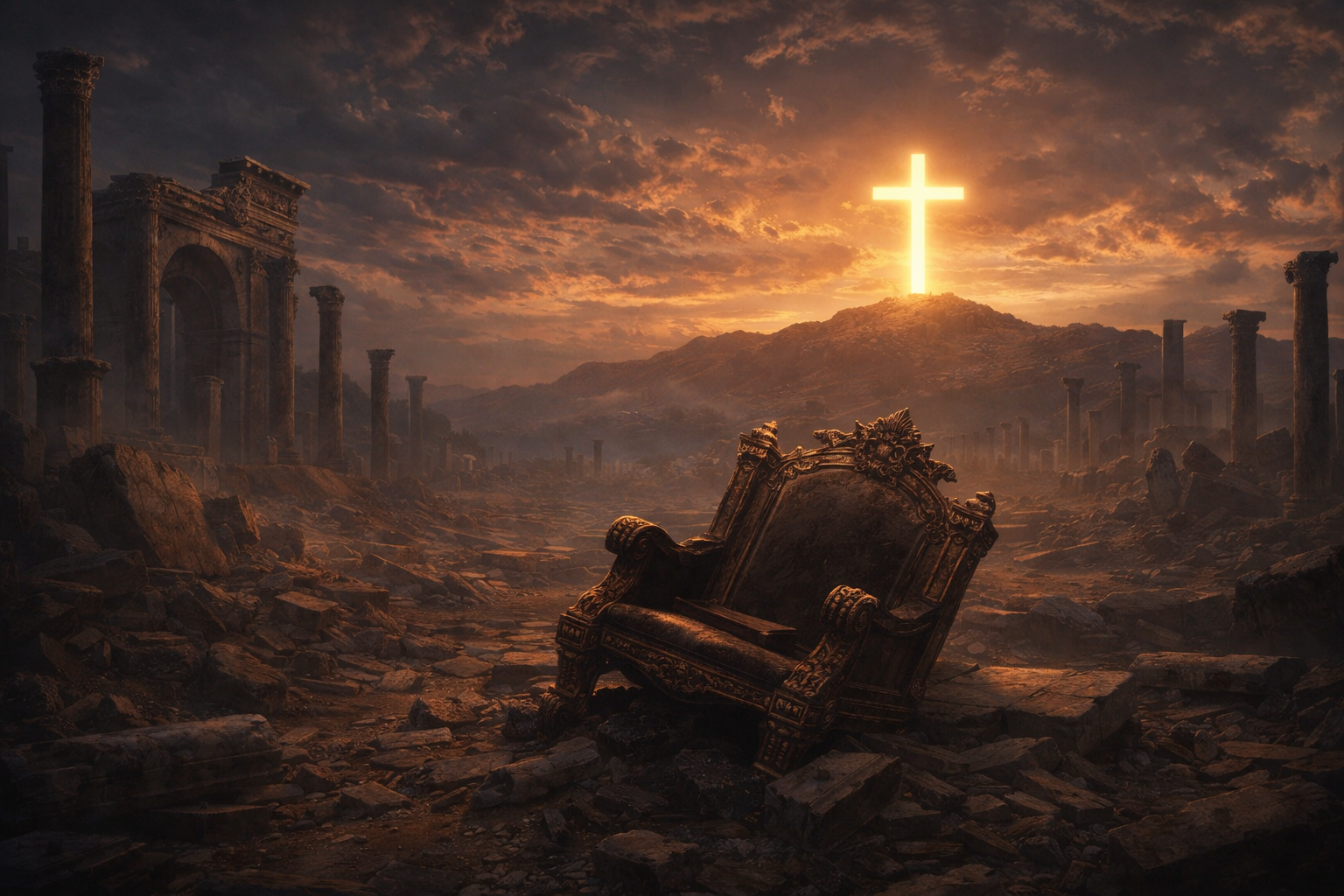
One of the most dangerous temptations in the history of God’s people is the temptation to put God’s name on our violence. It is one thing for nations to go to war. It is an entirely different matter for believers to declare that war as holy. Once that happens, bombs begin to look like sacraments, vengeance starts sounding like righteousness, and power dresses itself in the language of faith.
That is why Christians must refuse the idea of holy war. 1
The phrase sounds strong. It sounds morally serious. It sounds like conviction. But in reality it is often one of the cleverest ways empire recruits religion to bless its ambitions. It takes the fear of the people, the wounds of history, the language of justice, and the name of God, and weaves them into a story in which violence becomes sacred duty. But that is not the way of Jesus.
The Bible certainly knows the reality of war. Scripture is not naïve about power. It knows about violent rulers, crushed peoples, proud empires, and blood-soaked history. Egypt oppressed. Assyria devoured. Babylon destroyed. Rome crucified. But the New Testament will not allow the church to imagine that it can simply take Caesar’s sword, carve a cross into it, and call that Christian obedience.2
That is the point many believers still miss.
Too often Christians assume that if a cause seems morally urgent, then whatever is done in pursuit of it can be wrapped in biblical language. If the enemy seems wicked enough, if the threat feels serious enough, if the rhetoric sounds religious enough, then many begin to speak as though force itself has become holy. They may not use those exact words. But the message is clear enough: God is on our side, our enemies are beyond mercy, and violence is now part of our witness.
That is precisely where the church must stop and say no.
War May Be Tragic. But “Holy War” Is Something Else
War is always tragic. Even where force is used in a fallen world under limited and sobering conditions, it remains a sign that the world is not as it should be. Christians may debate questions of just war, state responsibility, defense, and restraint. Those are serious and difficult matters. But holy war is something more dangerous. It does not merely argue that force may sometimes be tragically necessary. It says violence can bear divine sanction in such a way that believers are invited to celebrate it as sacred.
That is where the corruption begins.
Once war becomes holy, repentance disappears. Once war becomes holy, the enemy is no longer considered a human being made in God’s image but as an object to be crushed. Once war becomes holy, self-criticism fades, because holy causes are thought to justify almost anything, leading to a dangerous mindset where individuals and groups may overlook moral implications and the consequences of their actions. Once war becomes holy, truth is one of the first casualties, because propaganda is now wrapped in a halo.3
This is why holy war is spiritually deforming. It does not simply destroy bodies. It reshapes hearts. It teaches believers to cheer what they should lament. It trains them to confuse rage with righteousness. It invites them to call wrath faithfulness and domination obedience.
Jesus Refused This Path
The clearest Christian answer to holy war is not found first in abstract theory but in the life of Jesus himself.
Jesus came announcing the kingdom of God. That announcement had public meaning. It challenged rival powers. It exposed false lords. It called Israel and the nations alike to account. But Jesus did not bring the kingdom by organizing armed revolt. He did not summon legions to destroy his enemies. He did not teach his disciples that the holiness of their cause gave them permission to baptize violence.
When he was tempted with the kingdoms of the world, he refused them on the devil’s terms (Matt. 4:8–10). When Peter reached for the sword, Jesus told him to put it away (Matt. 26:52). When he stood before Pilate, he declared that his kingdom does not advance in the way earthly kingdoms do, otherwise his servants would fight (John 18:36). And when he went to the cross, he absorbed the violence of the powers rather than sanctifying it.4
That matters more than many Christians realize.
If Jesus is the true revelation of God’s kingship, then Christians cannot define holiness in a way that leaves him behind. Holiness must align with the meaning the crucified Messiah embraced. The church cannot preach Christ crucified and then act as though redemption finally comes through superior firepower.
The cross stands forever as God’s judgment on the fantasy that violence can save.
Empire Loves Religious Blessing
Why, then, does holy war keep coming back?
Because empire is always looking for preachers.5
Political power is rarely satisfied with mere obedience. It wants moral validation. It wants priests, prophets, pundits, and pastors to tell the people that its violence is righteous, necessary, even blessed by heaven. Empire knows that fear can mobilize a population, but religion can sanctify that mobilization. Fear can make people comply. Religious language can make them feel clean while doing it. (For a contemporary example of faith leaders publicly praying over presidential power in the context of war, see this report from Baptist News Global.)
This is why Christians must stay alert. Empire does not always come to the church openly hostile. Sometimes it comes smiling, carrying a flag and a Bible, asking only for some blessing. A prayer for the nation. A sermon against the enemy. A declaration that this strike, this campaign, this retaliation, this destruction is somehow aligned with God’s purposes.
Many believers, seeking certainty in a frightening world, succumb easily to seduction.
They want to know who the good guys are. They want to believe force can clean the world up. They want to think that if their side wins, then righteousness has triumphed. But that is precisely how empire catechizes the church. It teaches Christians to see the world through the lens of threat, tribe, and vengeance rather than through the crucified Messiah who loved his enemies and prayed for those who killed him (Matt. 5:44; Luke 23:34).
A common objection is this: Didn’t God command Israel to conquer Canaan? Wasn’t that a kind of holy war? The honest answer is yes—in its Old Testament setting, Joshua presents the conquest as a unique, divinely commanded act tied to Israel’s unrepeatable vocation under the old covenant.
But that does not mean the church today is authorized to wage holy war. Israel at that stage of redemptive history was a covenant nation with a specific land-bound calling. The church is not a geopolitical nation-state. It is a transnational people gathered from every tribe and tongue under the lordship of Christ.
The decisive point is that the New Testament does not hand Joshua’s sword to the church. Jesus refuses the way of coercive conquest, rebukes the sword, and establishes a kingdom that advances not by killing enemies but by calling them to repentance, faith, and reconciliation (Matt. 26:52; John 18:36).
So while the conquest belongs to a real and difficult part of Israel’s story, it does not serve as a standing model for Christian mission. The church’s warfare is no longer against flesh and blood, but against sin, idolatry, and the powers of darkness (Eph. 6:12). Its weapons are truth, prayer, faithfulness, suffering witness, and the gospel itself.
In short: Joshua describes a unique moment in Israel’s history. Jesus forbids us from turning that moment into the church’s mission.
The Church Is Not Called to Baptize the Sword
None of this means the church is indifferent to evil. Quite the opposite. The church must name evil truthfully. It must defend the weak, protect the vulnerable, and resist lies. But it must do so as the church.
Its calling is not to make violence look sacred.
Its calling is to bear witness to a different kingdom.
That kingdom does not deny justice. But it knows that justice is corrupted the moment it is detached from truth, mercy, and humility. It knows that the state may wield force in a fallen world, yet the church must never confuse the vocation of the state with its own calling. The church must not serve as empire’s chaplain. It must live as the body of Christ.6
And Christ did not say, “Blessed are the triumphant.”
He said, “Blessed are the peacemakers” (Matt. 5:9).
He did not say, “Love your neighbors and crush your enemies.”
He said, “Love your enemies and pray for those who persecute you” (Matt. 5:44).
He did not conquer by making others bleed.
He conquered by pouring out his own life.
That is why the church cannot call holy what Christ came to expose.
What Christian Refusal Looks Like
Refusing holy war does not imply a lack of moral seriousness. It means taking Jesus with utmost seriousness.
It means Christians must be the people who resist the rush to sanctify violence. The people who ask hard questions when everyone else is chanting. These are the individuals who stand against the dehumanization of entire populations. The people who grieve every life made in God’s image. The people who will not let biblical language be used as fuel for hatred.
It means refusing sermons that turn geopolitics into a stage for sacred vengeance. It means refusing prophecy schemes that make war sound exciting. It means refusing nationalism when it dresses itself up as discipleship. It means refusing the lie that God’s kingdom advances through bombs, terror, and domination.
Above all, it means remembering that the church’s greatest act of public witness is not to out-shout empire but to embody an alternative community. A people shaped by truth instead of propaganda, mercy instead of revenge, faithfulness instead of panic, and hope instead of bloodlust.7
The world will call that weak. It called the cross weak, too.
But the gospel insists that what looks weak in God’s hands is stronger than the machinery of death. Rome had swords, crosses, prisons, and governors. Jesus had a table, a towel, a cross, and an empty tomb. Rome looked strong. Jesus looked defeated. Yet Rome is dust, and Christ is Lord.
A Better Way Than Holy War
That is why Christians must refuse holy war.
Not because evil is unreal. Not because justice is not relevant. Not because public life is unimportant. But because once war is called holy, the church has already begun to forget its Lord. The Lamb does not need the church to bless the beast’s violence. He calls the church to follow him instead.
And to follow him is to say, even in a world drunk on force, no war is holy simply because powerful people say it is, and no cause is Christian if it asks us to abandon the crucified Messiah to win.
The church does not bear witness to Christ by blessing the sword. It bears witness by following the Lamb, even when the world still believes violence can save.
Notes:
- John Howard Yoder, The Politics of Jesus, 2nd ed. (Grand Rapids, MI: Eerdmans, 1994).
↩︎ - N. T. Wright, Jesus and the Victory of God (Minneapolis: Fortress Press, 1996); James D. G. Dunn, Jesus Remembered (Grand Rapids, MI: Eerdmans, 2003). ↩︎
- Richard B. Hays, The Moral Vision of the New Testament: Community, Cross, New Creation (San Francisco: HarperSanFrancisco, 1996) ↩︎
- Michael J. Gorman, Reading Revelation Responsibly: Uncivil Worship and Witness (Eugene, OR: Cascade Books, 2011); John Howard Yoder, The Politics of Jesus. ↩︎
- Richard A. Horsley, Jesus and Empire: The Kingdom of God and the New World Disorder (Minneapolis: Fortress Press, 2003). ↩︎
- Lesslie Newbigin, Foolishness to the Greeks: The Gospel and Western Culture (Grand Rapids, MI: Eerdmans, 1986). ↩︎
- Stanley Hauerwas, The Peaceable Kingdom: A Primer in Christian Ethics (Notre Dame, IN: University of Notre Dame Press, 1983). ↩︎
Leave a Reply