Reading Romans 15:22–33
Paul’s reflections in Romans 15:22–33 read like travel notes, but beneath the surface lies a profound theology of mission, unity, and costly obedience. These lines expose the heartbeat of a man whose vocation is shaped by the Messiah’s story and empowered by the Spirit’s energy. They offer not a logistical appendix but a theological window: the gospel creates a people whose plans, resources, and prayers are caught up in God’s redemptive project.
What emerges is a portrait of the early church learning to live as a single family drawn from Jews and Gentiles, propelled outward toward a world still waiting for the healing reign of God.
I. Why Paul’s Plans Were Interrupted (vv. 22–24)
Paul begins with an explanation: “I have often been hindered from coming to you.” The hindrance is not persecution or administrative delay but mission itself. He has been occupied with announcing the good news “where Christ has not been named,” echoing his principle in 2 Corinthians 10:15–16—not building on another’s foundation.
Mission here is not a ministry hobby but the gravitational pull of the new creation. The Spirit continually presses Paul into frontier territory (Rom 15:20). Every church planter knows the tension: long-established communities he yearns to visit must sometimes wait because the gospel keeps driving him to places where no foundation yet exists.
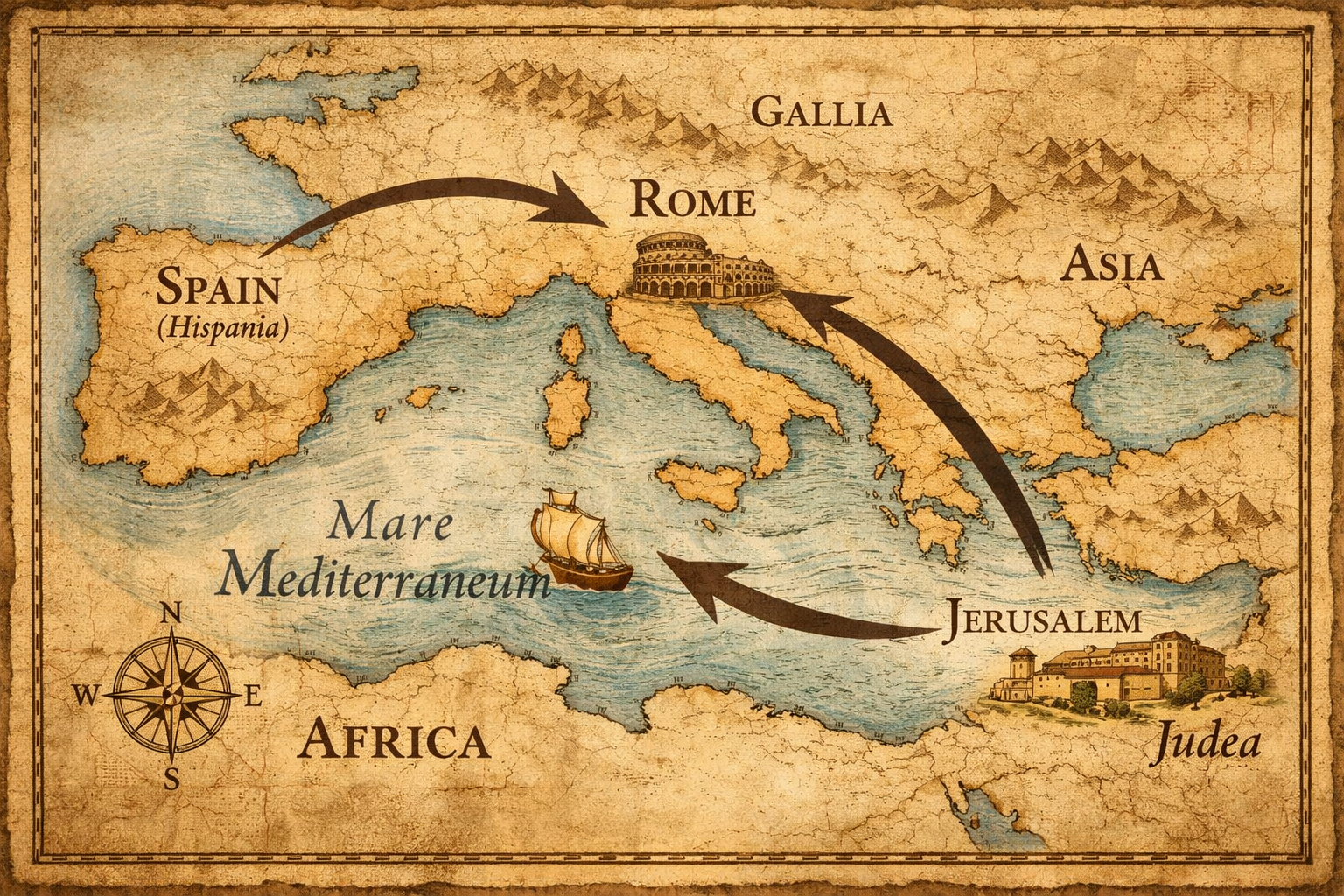
Yet Paul does not treat Rome as an afterthought. He longs for mutual strengthening (Rom 1:11–12), for shared refreshment in the Spirit, and for Rome to serve as a sending base for his westward movement into Spain. The church in Rome is both a beloved congregation and a missionary launchpad. The gospel always nurtures communities and pushes them outward simultaneously.
II. The Jerusalem Collection as Eschatological Symbol (vv. 25–29)
Before Spain—and even before Rome—Paul must go eastward to Jerusalem. The Gentile churches of Macedonia and Achaia have prepared a contribution for the “poor among the saints” in the holy city (Rom 15:26). On the surface this looks like philanthropy, but for Paul it is theology embodied.
Gentile believers share materially because they already share spiritually in the story of Israel. As Paul puts it, “They were pleased to do it, and indeed they owe it to them” (Rom 15:27). Their generosity flows from the reality that they have been grafted into Israel’s covenant story (Rom 11:17–24). They have received the Messiah of Israel, the Spirit promised to Israel, and the Scriptures preserved by Israel. The collection makes this reality visible.
This is exactly the kind of unity envisioned in Ephesians 2:11–22, where Gentiles are brought near, reconciled, and made part of God’s household. It is not abstract theological unity but unity enacted—unity that costs something.
Paul knows the risks of going to Jerusalem. He prays for deliverance from the unbelievers there (Rom 15:31), where suspicion surrounds him and previous conflicts have marked his reputation (Acts 21:27–36). Yet for him this is the path of faithfulness. Reconciliation must be performed, not merely explained. The collection is a sign that the age of division is passing away and the new creation is appearing (2 Cor 5:17).
When Paul anticipates arriving in Rome “in the fullness of the blessing of Christ” (Rom 15:29), he likely envisions the strengthening effect of having completed this dangerous, symbolic act. Blessing here aligns with the eschatological blessing described in Ephesians 1:3–10—God’s plan to bring unity to all things in the Messiah. What he brings to Rome is thus not a private spiritual state but the fruit of God’s reconciling work made visible among Jews and Gentiles.
III. Prayer as Participation in the Struggle (vv. 30–33)
Paul closes with an urgent appeal: “Strive together with me in your prayers to God.” The verb συναγωνίζεσθαι evokes athletic contest and struggle—the same imagery found in Colossians 1:29 and again in 1 Corinthians 9:24–27. Prayer is not polite religious ritual; it is missional participation, joining the apostolic conflict.
He asks for three things:
- Deliverance from unbelieving Judeans (Rom 15:31a)
- Acceptance of the Gentile gift by the Jerusalem church (Rom 15:31b)
- Joyful, Spirit-led fellowship with the Roman believers (Rom 15:32)
These requests reveal the true texture of mission: spiritual conflict, relational vulnerability, and vocational uncertainty. Paul’s work is never insulated from danger. Mission is not triumphant heroism; it is Spirit-dependent obedience.
Paul concludes with a blessing: “The God of peace be with you all” (Rom 15:33). Peace here reflects not ease but the unfolding faithfulness of the God who unites Jew and Gentile in a single family and guides His people through risk toward hope.
IV. Theological Trajectory: What Romans 15:22–33 Teaches the Church Today
1. The Gospel Disrupts Personal Plans
Paul’s movements are repeatedly rerouted by the Spirit’s call (Acts 16:6–10). Faithfulness requires openness to God’s interruptions. Mission today likewise demands flexibility, courage, and discernment.
2. Unity Must Become Visible
Just as the Jerusalem collection dramatized reconciliation, so must the church today embody unity through shared resources, shared burdens, and shared mission (Gal 6:6). True unity is incarnated, not merely stated.
3. Mission Advances Through Partnership
Paul depends deeply on the Roman church’s prayers and support (Rom 15:30–32). Mission remains a communal vocation, not an individual performance.
4. Prayer Is Missional Labor
To pray is to join the struggle. The church is summoned to an “agonizing” partnership in God’s purposes (Col 4:12). Prayer pushes mission forward.
5. The Church Lives Between Promise and Risk
Paul walks into danger because he trusts the God who is carrying history toward its intended goal (Rom 8:28; Rom 8:18–25). Authentic discipleship still holds this tension—obedience with uncertainty anchored in hope.
Conclusion: A Gospel on the Move
Romans 15:22–33 is not an appendix; it is mission, unity, and prayer in motion. The gospel reshapes Paul’s plans, binds diverse communities into one family, and summons believers into Spirit-led partnership across boundaries. In these verses, we witness a faith that travels, reconciles, struggles, and hopes.
To read them well is to recover our own vocation: to be a people reshaped by hope, unified in love, generous in practice, and ready to follow wherever the Messiah leads.
Recommended Readings
- Dunn, James D. G. The Theology of Paul the Apostle. Grand Rapids: Eerdmans, 1998.
- Barclay, John M. G. Paul and the Gift. Grand Rapids: Eerdmans, 2015.
- Gaventa, Beverly Roberts. When in Romans: An Invitation to Linger with the Gospel According to Paul. Grand Rapids: Baker Academic, 2016.
- Hays, Richard B. Echoes of Scripture in the Letters of Paul. New Haven: Yale University Press, 1989.
- Esler, Philip F. Conflict and Identity in Romans: The Social Setting of Paul’s Letter. Minneapolis: Fortress Press, 2003.
Leave a Reply