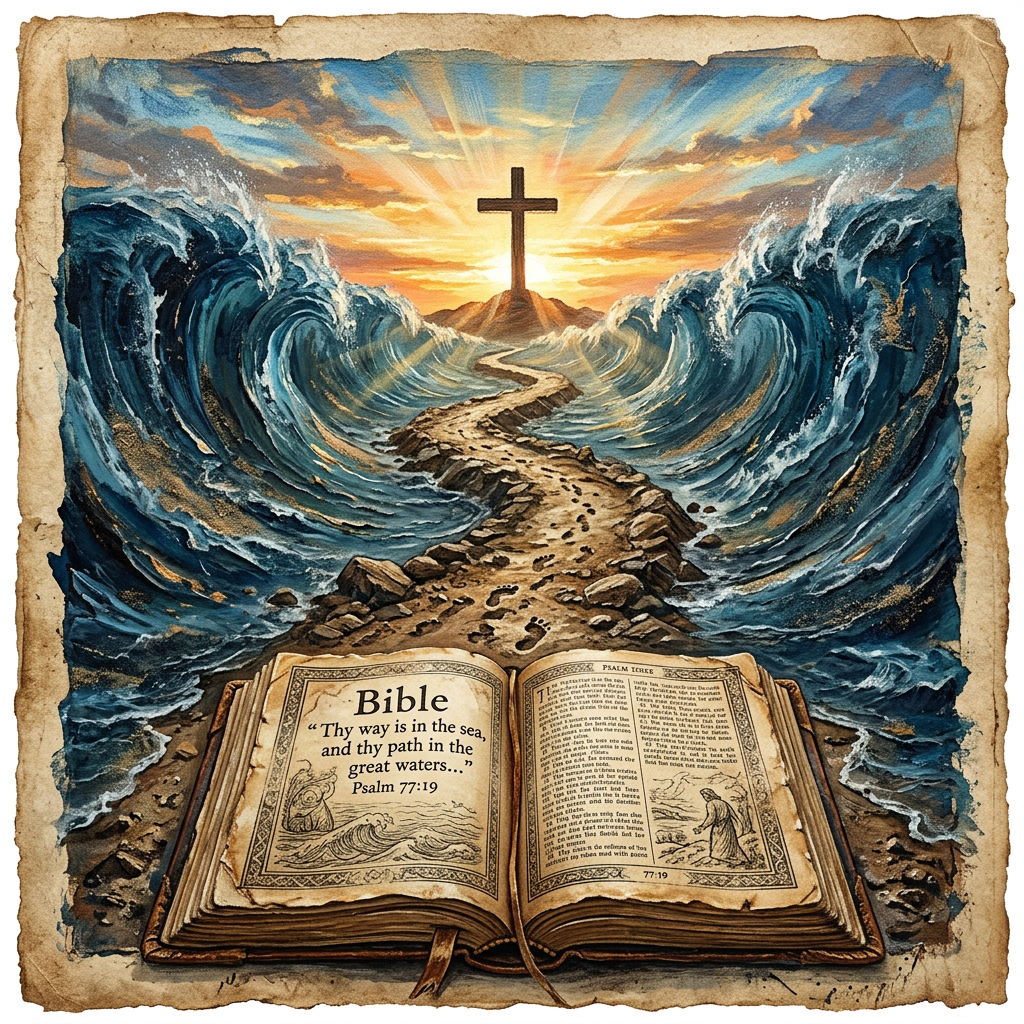
The Exodus shapes the New Testament gospel by providing Scripture with one of its central patterns of redemption. In Egypt, God delivered a helpless people from slavery, brought them through the sea, established his covenant, and came to dwell among them. In Jesus Christ, this pattern reaches its fulfillment as God rescues his people from sin, death, and the powers of evil and leads them toward new creation.
The New Testament assumes this pattern at almost every turn. Jesus is presented as the true Passover Lamb, the greater Moses, the faithful Son, and the one who leads his people out of bondage. His death accomplishes deliverance, his resurrection opens the way into new creation, and the gift of the Spirit establishes God’s presence among a renewed covenant people.
The gospel, therefore, is not an isolated message detached from Israel’s story. It is the announcement that the God who acted in the first exodus has acted decisively again. Through the death and resurrection of Jesus, he has defeated the powers that enslave humanity and has begun leading his people toward their promised inheritance.
The Exodus Establishes the Pattern of Redemption
The book of Exodus begins with Israel in bondage. Abraham’s descendants have become slaves under Pharaoh, a ruler who claims authority over their bodies, their labor, and even the lives of their children. Israel cannot negotiate its own freedom or overpower Egypt. If redemption is to occur, God must act.
That divine action begins with God’s covenant faithfulness. The Lord hears Israel’s groaning and remembers his covenant with Abraham, Isaac, and Jacob (Exodus 2:23–25). His remembrance does not imply that he had temporarily forgotten them. It means that the time has come for him to act publicly in fulfillment of his promises.
This order is essential to biblical salvation. God does not rescue Israel because the nation has proved itself worthy. He rescues Israel because he is gracious and faithful. Redemption precedes obedience. The law is not a ladder by which Israel climbs out of Egypt; it is the gracious instruction given to a people whom God has already delivered.
The same order appears in the gospel. Sinners do not free themselves from guilt, corruption, and death by moral achievement. God acts for the helpless through Jesus Christ. Those united to Christ are justified by grace through faith, and their obedience follows as the grateful response of a redeemed people.
Jesus Relives Israel’s Story
The Gospel writers deliberately present Jesus within the pattern of the exodus. Matthew describes the child Jesus being taken into Egypt and later returning, applying Hosea’s words to him: “Out of Egypt I called my son” (Matthew 2:15). In Hosea, the son is Israel. Matthew applies the text to Jesus because Jesus embodies Israel’s calling and brings Israel’s history to its intended fulfillment.
Israel was called God’s firstborn son but repeatedly failed to trust and obey him. Jesus is the faithful Son who succeeds where Israel failed. He passes through the waters of baptism and is led by the Spirit into the wilderness. There he faces temptation for forty days, recalling Israel’s forty years in the wilderness, yet he remains faithful to his Father.
Jesus does not simply imitate Israel’s story from a distance. He takes Israel’s vocation upon himself. He is the representative Messiah in whom God’s covenant purposes reach their climax. Where Israel grumbled, rebelled, and turned to idols, Jesus offers perfect trust and obedience. He becomes the faithful Israelite through whom blessing can finally reach the nations.
Jesus is also portrayed as a greater Moses. Like Moses, he escapes a murderous ruler in infancy, comes out of Egypt, passes through water, enters the wilderness, ascends a mountain, and gives authoritative instruction. Yet Jesus is more than another prophet. Moses speaks as God’s servant, while Jesus speaks as the Son who possesses divine authority. Moses leads Israel out of political slavery, but Jesus confronts the deeper powers of sin, Satan, and death.
The Cross Is the True Passover
The clearest connection between the exodus and the gospel appears in the Passover. On the night of Israel’s deliverance, judgment falls upon Egypt, but God provides a means of refuge. A lamb is slain, its blood marks the Israelite homes, and death passes over those who shelter beneath God’s provision.
The lamb does not deliver Israel because of some power inherent in the animal. Its blood is effective because God has appointed it as the sign of his saving promise. Israel is spared by trusting the means God provides. The Passover consequently becomes the defining memorial of Israel’s redemption.
The New Testament identifies Jesus as the fulfillment of this pattern. John the Baptist announces him as “the Lamb of God, who takes away the sin of the world” (John 1:29). Paul states that “Christ, our Passover lamb, has been sacrificed” (1 Corinthians 5:7). The Gospel of John places particular emphasis upon the Passover setting of Jesus’ death, showing that the crucifixion is the moment when God’s greater deliverance is accomplished.
At the Last Supper, Jesus takes Israel’s Passover meal and centers it upon himself. The bread signifies his body given for his people, while the cup signifies his blood of the covenant poured out for the forgiveness of sins. Jesus is both the mediator of the new exodus and the sacrifice through which that exodus becomes possible.
The cross is therefore more than an example of sacrificial love, although it certainly reveals such love. Jesus bears the judgment deserved by covenant breakers. He gives his life as a ransom, carries the curse of sin, and reconciles the guilty to God. Divine justice is not ignored; it is satisfied through the self-giving sacrifice of the Son.
Yet the cross is also a victory over the enslaving powers. Just as Pharaoh’s claim over Israel was broken, the authority of sin, death, and the devil is broken through Christ. At the cross, Jesus disarms the powers and triumphs over them (Colossians 2:13–15). Substitution and victory belong together: Christ defeats our enemies precisely by bearing our guilt and exhausting sin’s condemnation.
The Resurrection Is the Passage Through the Sea
Israel’s departure from Egypt was not complete until the people passed through the sea. Behind them stood Pharaoh and his armies; before them lay an apparently impassable barrier. God opened a path where no human path existed, brought his people through, and overwhelmed the power that pursued them.
The New Testament presents the resurrection of Jesus as an even greater act of deliverance. At the cross, Jesus enters the full depth of humanity’s bondage and death. In the resurrection, God opens a way through death itself. The enemy that appeared to possess the final word is defeated, and Jesus emerges as the beginning of new creation.
The resurrection is not merely proof that life continues after death. It is God’s declaration that Jesus is Messiah and Lord, that his sacrifice has been accepted, and that the new age has begun. Christ is the firstfruits of those who will be raised (1 Corinthians 15:20). His resurrection guarantees that everyone united to him will share in his victory.
Christian baptism draws upon this exodus pattern. Paul describes Israel’s passage through the sea as a kind of baptism into Moses, while believers are baptized into Christ’s death and resurrection (1 Corinthians 10:1–2; Romans 6:3–4). Baptism does not celebrate human self-improvement. It declares that the believer’s old master has been judged and that a new life under the lordship of Jesus has begun.
The Gospel Creates a Covenant People
The exodus was never only about rescuing separate individuals. God delivered a people. At Sinai he declared that Israel would be his treasured possession, a kingdom of priests, and a holy nation (Exodus 19:4–6). Redemption brought Israel into a new identity, a covenant relationship, and a shared vocation.
The New Testament applies this language to the church. Peter addresses believers as “a chosen people, a royal priesthood, a holy nation” who have been called out of darkness into God’s marvelous light (1 Peter 2:9). Jews and Gentiles who belong to Christ are gathered into one covenant family, not because of ethnicity, moral achievement, or works of the law, but because of God’s grace received through faith.
This does not mean that the church can treat Israel’s history as disposable. The church has no story apart from Israel’s Scriptures and Israel’s Messiah. Gentile believers have been welcomed into promises they did not create and are sustained by a Jewish Savior. The new covenant people do not replace God’s faithfulness to Israel; they demonstrate that Israel’s vocation to bring blessing to the nations is reaching its intended goal in Christ.
As in the first exodus, redemption creates an obligation to holiness. God does not liberate people so that they may invent new forms of slavery. Believers have been set free from sin in order to become servants of righteousness. Obedience does not purchase redemption, but redemption necessarily produces a new allegiance.
God Comes to Dwell Among His People
The goal of the exodus was not merely departure from Egypt. God brought Israel to himself so that he might dwell among them. The tabernacle stood at the center of Israel’s life as the sign of God’s holy presence, although sin continually disrupted that fellowship.
In the New Testament, the promise of God’s presence reaches a greater fulfillment. The eternal Word becomes flesh and “tabernacles” among us in Jesus Christ (John 1:14). Jesus is the true meeting place between God and humanity. Through his death, sinners receive access to God, and through the Holy Spirit, God makes the church his dwelling.
Pentecost therefore belongs to the new-exodus gospel. The Spirit forms a holy people, writes God’s instruction upon their hearts, and empowers them for faithful witness. God is no longer present in a portable sanctuary at the center of one nation. He dwells within his people and sends them among the nations as living signs of his coming renewal.
The Wilderness Still Lies Between Redemption and Inheritance
Israel’s passage through the sea was followed by a wilderness journey. The people had truly been delivered, but they had not yet entered the promised land. The wilderness became a place of testing, provision, discipline, and dependence upon God.
The church lives within a similar tension. Christ has defeated the decisive enemies, believers have received the Spirit, and new creation has begun. Nevertheless, suffering, temptation, and death remain present. Christians live between the accomplished victory of the resurrection and the future renewal of all things.
This wilderness existence explains why the New Testament repeatedly calls believers to perseverance. The warnings drawn from Israel’s failures are real. Privilege must not be confused with faithfulness, and an initial profession must not be used as an excuse for unbelief. At the same time, God continues to provide for his people through his Word, his Spirit, the fellowship of the church, and the covenant meal Christ has given.
The Lord’s Supper is therefore both a Passover memorial and a wilderness provision. The church remembers the death through which it was delivered, feeds upon Christ by faith, and anticipates the marriage supper of the Lamb. The meal looks backward to the cross and forward to the promised inheritance.
The New Exodus Ends in New Creation
The promised inheritance of the gospel is larger than escape from judgment or departure to a disembodied heaven. Just as the first exodus moved toward a land in which God would dwell with his people, the new exodus moves toward the renewal of creation.
The book of Revelation brings exodus imagery to its final horizon. The powers of evil resemble oppressive empires, plagues announce divine judgment, and the redeemed sing the song of Moses and the Lamb (Revelation 15:2–4). God’s people are finally delivered from every Pharaoh-like power, while death itself is cast down.
The destination is a renewed heaven and earth in which God dwells permanently with humanity. The whole creation becomes the holy place, and the glory of God fills it. The gospel does not end with redeemed souls fleeing the world but with resurrected people inhabiting God’s restored creation under the reign of Christ.
Living as a New-Exodus People
Seeing the gospel through the exodus keeps salvation both personal and cosmic. It is personal because Christ forgives our sins, reconciles us to God, and frees us from the dominion of evil. It is cosmic because the risen Lord is reclaiming the creation, defeating every hostile power, and forming a people from every nation.
This vision also prevents the gospel from being reduced either to political liberation or to private spirituality. The biblical gospel certainly confronts oppression, idolatrous power, and the dehumanization of the vulnerable. Yet it also identifies the deeper bondage within every human heart. We need deliverance not only from oppressive systems but from our own guilt, rebellion, and enslavement to sin.
The church bears witness to this deliverance by proclaiming Christ and embodying the life of his kingdom. When Christians worship God rather than Caesar, welcome strangers, share resources, pursue holiness, defend the vulnerable, forgive enemies, and remain faithful in suffering, they demonstrate that another Lord has claimed them. Their common life becomes a sign that the powers of the old age do not possess ultimate authority.
The exodus thus gives the New Testament gospel its narrative shape. Humanity lies under powers it cannot defeat, but God has remembered his covenant and acted in grace. Jesus, the faithful Son and true Passover Lamb, has borne judgment and broken the enemy’s claim. His resurrection has opened a way through death, his Spirit now dwells among his people, and his church travels through the wilderness toward new creation.
The Christian hope rests upon the same truth Israel learned at the edge of the sea: salvation belongs to the Lord. The God who brought his people out of Egypt has acted once for all through Jesus Christ, and he will not abandon the people he has redeemed. The new exodus has begun, the Lamb has conquered, and the journey will end with God dwelling among his people in a world made new.
Call to Action
The Exodus invites us to see the gospel as more than private forgiveness or escape from the present world. Through Jesus Christ, God has delivered a people, defeated their enslaving powers, given them his Spirit, and set them on the road toward new creation. Continue exploring this unified biblical story in Why Covenant Is Central to the Biblical Story and The Kingdom of God: The Bible’s Central Announcement.
Frequently Asked Questions
These questions explain how the Exodus shapes the New Testament gospel and finds its fulfillment in Jesus Christ.
How does the Exodus point to Jesus?
The Exodus establishes the biblical pattern of God rescuing a helpless people from slavery, bringing them through judgment, establishing a covenant with them, and dwelling in their midst. Jesus fulfills this pattern by delivering his people from sin, death, and the devil through his crucifixion and resurrection.
Why is Jesus called the Passover Lamb?
At the first Passover, a lamb was sacrificed and its blood marked God’s people as they sheltered from judgment. The New Testament identifies Jesus as the true Passover Lamb because he bears judgment in the place of sinners and secures their deliverance through his sacrificial death.
What is the new exodus in the New Testament?
The new exodus is the greater redemption accomplished through Jesus Christ. It includes forgiveness, liberation from the dominion of sin, victory over the powers of evil, incorporation into God’s covenant people, and the promise of resurrection life in the renewed creation.
How is Christian baptism connected to the Exodus?
Paul treats Israel’s passage through the sea as a form of baptism into Moses. Christian baptism signifies union with Christ in his death and resurrection, declaring that the believer has left the dominion of the old master and entered a new life under the lordship of Jesus.
Is the gospel primarily a message of political liberation?
The historical Exodus reveals that God opposes oppression and hears the cries of the suffering, but the New Testament exposes an even deeper bondage affecting rulers and subjects alike. Jesus delivers humanity from guilt, sin, death, and the devil while forming a people whose life challenges injustice, idolatry, and dehumanizing power.
What does the Exodus teach about Christian obedience?
The Exodus shows that grace precedes obedience. God first redeemed Israel and then gave the law, just as Christians are saved by grace through faith and subsequently called to holiness as the grateful fruit of redemption rather than its cause.
Bibliography
- Beale, G. K. A New Testament Biblical Theology: The Unfolding of the Old Testament in the New. Grand Rapids: Baker Academic, 2011.
- Beale, G. K., and D. A. Carson, eds. Commentary on the New Testament Use of the Old Testament. Grand Rapids: Baker Academic, 2007.
- Childs, Brevard S. The Book of Exodus: A Critical, Theological Commentary. Old Testament Library. Philadelphia: Westminster Press, 1974.
- Estelle, Bryan D. Echoes of Exodus: Tracing a Biblical Motif. Downers Grove, IL: IVP Academic, 2018.
- Hays, Richard B. Echoes of Scripture in the Gospels. Waco, TX: Baylor University Press, 2016.
- Morales, L. Michael. Exodus Old and New: A Biblical Theology of Redemption. Essential Studies in Biblical Theology. Downers Grove, IL: IVP Academic, 2020.
- Pao, David W. Acts and the Isaianic New Exodus. Biblical Studies Library. Grand Rapids: Baker Academic, 2002.
- Watts, Rikki E. Isaiah’s New Exodus and Mark. Wissenschaftliche Untersuchungen zum Neuen Testament 2/88. Tübingen: Mohr Siebeck, 1997.
- Wright, N. T. Jesus and the Victory of God. Christian Origins and the Question of God, vol. 2. Minneapolis: Fortress Press, 1996.
- Wright, N. T. The Resurrection of the Son of God. Christian Origins and the Question of God, vol. 3. Minneapolis: Fortress Press, 2003.
Image disclosure: This featured image is an AI-generated biblical illustration.