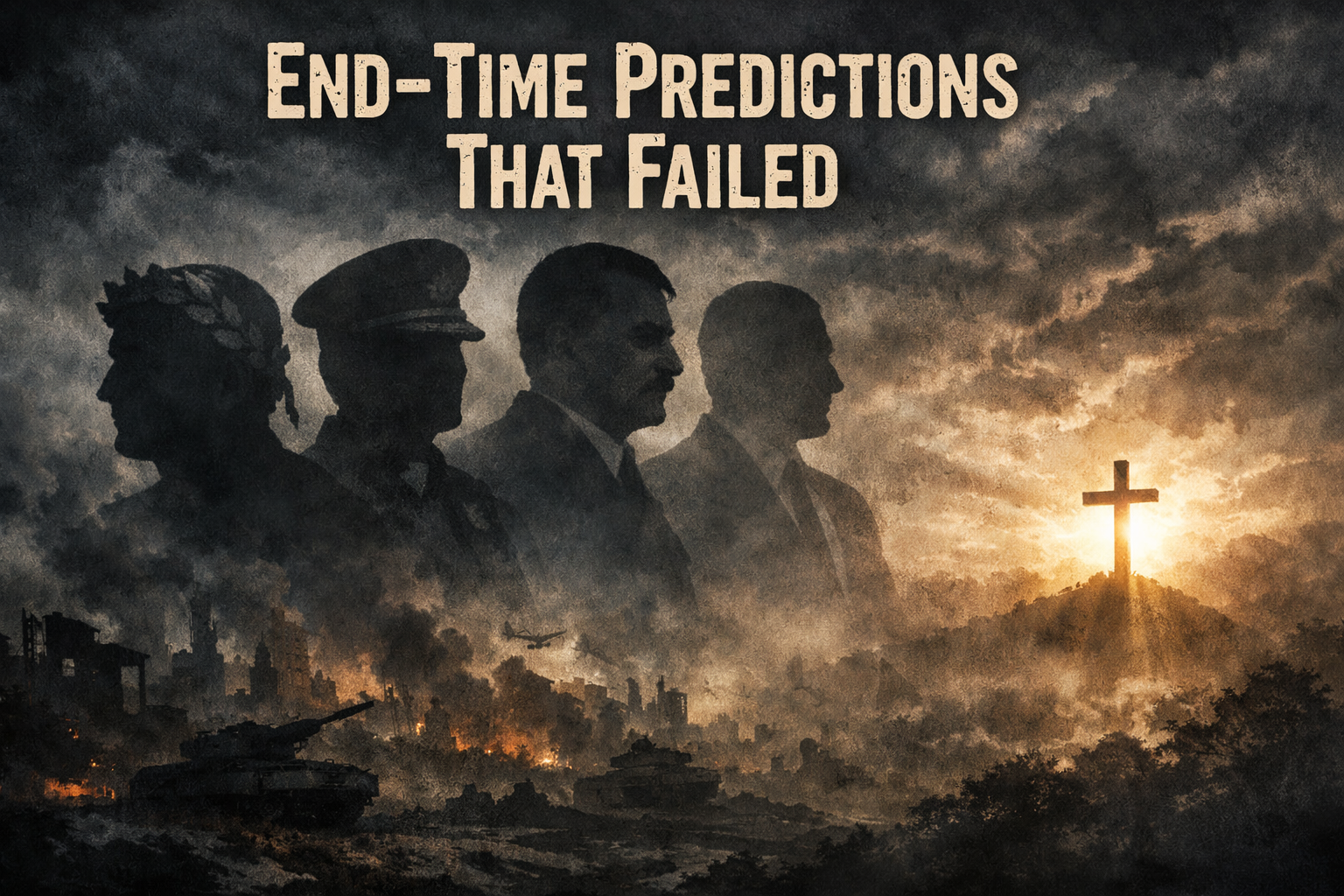
Every generation seems to produce its own version of the same fear. A ruler rises. Nations tremble. Violence spreads. The language becomes absolute. This is the one, people say. This is the final tyrant. This is the sign that history has reached its breaking point. And before long, anxious Christians begin to read the headlines not simply as headlines, but as a coded script for the end.
We have seen this kind of thing before.
The early Christians had Nero. Later generations had emperors, persecutors, and would-be saviors of civilization. The modern world had Hitler, whose name still stands as a chilling symbol of political evil, racial arrogance, and organized destruction. And now, in our own time, every fresh strongman, every war scare, every tremor in the Middle East, every public threat, every realignment of nations becomes for some believers proof that the final scenario has at last arrived.
But the church must learn to say something wiser, calmer, and more faithful.
Why the Pattern Keeps Returning
History is indeed littered with this kind of story. That is precisely the point. If the same pattern keeps returning, then perhaps the lesson is not that we have finally cracked the prophetic code. Perhaps the lesson is that human power keeps repeating its old habits. The masks change. The costumes change. The slogans change. The weapons become more sophisticated. But the drama remains painfully familiar. Empire still demands loyalty. Rulers still magnify themselves. Nations still baptize their violence. Crowds still long for a strong hand to save them. And frightened believers still feel the pull to turn every crisis into a countdown.
Jesus warned his followers that they would hear of “wars and rumors of wars,” but he immediately added, “see that you are not alarmed” (Matt. 24:6). That word matters. He did not tell his people to deny the turmoil. He did not tell them to pretend that history would be peaceful until the very end. He told them not to panic. In other words, turmoil in the world is not itself a secret key. It is part of the broken condition of the present age.
The Bible, then, trains us not to be naïve, but neither does it train us to be hysterical.
The church has heard “this is it” many times before.
- 1666 — “The Year of the Beast”: Because of the number 666, many feared that 1666 would bring the end. Even the Great Fire of London was read by some as apocalyptic, yet history continued.
- 1814 — Joanna Southcott: Southcott claimed she would give birth to the messiah and that the last days would follow. It did not happen.
- 1843–1844 — William Miller and the Great Disappointment: Miller predicted Christ’s return around 1843; when that failed, October 22, 1844, became the revised date. Christ did not return.
- 1994, May 21, 2011, and October 21, 2011 — Harold Camping: Camping repeatedly predicted the end and repeatedly revised his dates. None came to pass.
- 2012 — The Mayan calendar panic: Many treated December 21, 2012 as an apocalyptic deadline, but the date passed like any other.
- September 23, 2017 — David Meade’s “Nibiru” prophecy: Meade claimed biblical numerology pointed to the end beginning on that date. Nothing happened.
- October 15, 2017, then April 23, 2018 — revised Meade dates: After September failed, new dates were proposed. These also passed uneventfully.
- April 8, 2024 — eclipse prophecy hype: Some treated the North American solar eclipse as a likely herald of the Second Coming or divine judgment. The eclipse came and went.
- September 23–24, 2025 — viral “Rapture” prediction: Online prophecy voices claimed the Rapture would happen on those dates. It did not.
The pattern is painfully familiar: crisis rises, prophecy talk intensifies, date-setters gain an audience, and then history moves on. The lesson is not that Christians need a better chart, but that the church must refuse fear-driven speculation and remain faithful, sober, and hopeful.
The Bible Knows the Powers Can Become Beastly
Scripture knows perfectly well that political power can become beastly. It knows what happens when rulers behave as though they were answerable to no one. It knows the arrogance of empire, the seduction of propaganda, and the terrible ease with which public violence can be dressed up as destiny. The Bible is not romantic about nations. It knows that the powers can devour the weak, distort truth, and demand from human beings the kind of loyalty that belongs to God alone.
Yet for that very reason, the people of God are forbidden from panic.
This is where end-time enthusiasts often go badly wrong. They think fear is proof of seriousness. They think anxiety is a mark of watchfulness. They think a breathless reading of current events is evidence of spiritual alertness. But Christian vigilance is not the same thing as prophetic panic. The New Testament calls believers to sober discernment, not to a feverish obsession with matching texts to headlines.
When Fear Masquerades as Watchfulness
The problem with this fear-driven approach is not only that it keeps making overconfident predictions. History has already exposed that weakness often enough. The deeper problem is that it forms Christians into people of dread rather than people of hope. It teaches them to scan the news more eagerly than they pray, to follow military developments more closely than they follow Christ, and to identify villains more quickly than they practice love, holiness, and endurance. In that climate, faith slowly becomes fear with Bible language attached.
That is not the gospel.
The gospel announces that Jesus, not Caesar, is Lord. That single confession changes everything. Once Jesus is confessed as Lord, every earthly ruler is put in their place. However impressive they may appear, they are not ultimate. However dangerous they may become, they are not sovereign. God has exalted Jesus above every name and placed all things under his feet (Phil. 2:9–11; 1 Cor. 15:25–27). That means history does not belong to the latest tyrant. It belongs to the crucified and risen Messiah.
Christ, Not Caesar, Holds History
That truth gives the church a different posture in troubled times.
It means we can look evil in the face without pretending it is good. We can name injustice without collapsing into despair. We can resist propaganda without producing our own sensational timelines. We can acknowledge recurring patterns of violence and arrogance without assuming that each recurrence gives us a fresh chart of the last days. The church’s calling is not to decode every headline, but to remain faithful in every age.
And faithfulness has always looked more ordinary than the fear-merchants would have us believe.
It looks like patient endurance. It looks like refusing lies. It looks like communities that care for the weak while the powerful posture and threaten. It looks like prayer that is not escapist, but rooted in the conviction that God will judge the world justly. It looks like churches whose life is shaped not by panic, but by the peace of Christ. It looks like believers who know that the powers are real, but who know even more deeply that the powers are not final.
The Powers Are Real, but They Are Not Final
Paul says that in the cross, God disarmed the powers and authorities and made a public spectacle of them in Christ (Col. 2:15). That does not mean the powers have ceased to do damage. Clearly they still wound, deceive, and destroy. But it does mean they have been unmasked. They are no longer entitled to our awe. Their claim to ultimacy has been broken. They may still shout, threaten, and intimidate. They may still act with terrifying force. But they do not hold the future.
That is why Christians do not need to be manipulated by every new prophecy scare.
Yes, history is moving toward its God-appointed goal. It is not an endless wheel turning without meaning. The world is not trapped in a flat cycle of chaos forever. God is bringing all things toward their proper end. There is indeed a telos. But that truth should make us steady, not frantic. The fact that history has a goal does not authorize speculative panic. It calls for durable hope.
History Has a Telos, Not a Panic Button
And durable hope is exactly what fearful Christians need.
They need to be reminded that the church has passed through many dark hours before. Believers endured Nero without surrendering to Nero’s story. Christians lived through collapsing orders, invasions, persecutions, dictatorships, and world wars. Some generations surely felt that evil had reached its final and fiercest form. Yet the people of God were not saved by their ability to identify the last villain. They were sustained by their confidence that nothing in all creation can separate them from the love of God in Christ Jesus our Lord (Rom. 8:38–39).
That same confidence is needed now.
So when end-time enthusiasts point to the latest conflict and say, “This is it,” the church should answer with caution and courage. We have heard this kind of claim before. We have seen this kind of fear before. We have watched Christians be whipped into prophetic excitement before. And history has taught us that the kingdom of God does not arrive because someone successfully matched this week’s headlines to an ancient verse. The kingdom comes because God is faithful to his Son and faithful to his promise.
The Church’s Calling: Hope, Not Panic
That is where our security lies.
Not in our ability to identify the antichrist behind every podium.
Not in a new theory about the final war.
Not in the thrill of thinking we are the one generation that has finally solved the puzzle.
Our security lies in Christ, who has already faced the worst the powers can do and has already been vindicated by God.
So let the fear-sellers speak in urgent tones if they must. Let them keep naming the newest monster as the final one. The church must not join them. Our calling is harder and better: to be sober without being shaken, alert without being alarmist, and hopeful without being naïve.
History may keep producing new Neros and new Hitlers. But history does not belong to Nero, Hitler, or any present-day imitator. History belongs to the God who raised Jesus from the dead and who will, in the end, set the world right.
And because that is true, Christians do not need to live by panic.
They are free to live by hope.
History may keep producing new beasts, but the church must remember: the beast never gets the last word. Christ does.
Leave a Reply