Eschatological Maturity and Heavenly Citizenship in Philippians 3:12–21
Philippians 3:12–21 marks the theological and pastoral culmination of Paul’s argument in chapter three. Having dismantled confidence in covenantal privilege and redefined righteousness around participation in the Messiah (3:4–11), Paul now corrects any triumphalist misreading of his claims. Resurrection life has begun—but it has not yet been consummated. Christian existence unfolds within the tension between what has already been inaugurated and what still awaits fulfillment.1
Paul states this plainly: “Not that I have already obtained this or have already been perfected” (3:12). The verb “τετελείωμαι” (from “τελειόω”) carries the sense of reaching completion or attaining the intended τέλος—the goal. The perfect tense suggests a settled condition of arrival, which Paul emphatically denies. Participation in Christ does not equal eschatological completion2. The apostle refuses to confuse inauguration with consummation.
Yet this denial of perfection does not result in passivity. Instead, Paul declares, “I press on” (διώκω). The irony is deliberate. Earlier he described himself as one who “persecuted” (διώκων) the church (3:6). The persecutor has become the pursuer. Grace has not diminished effort; it has redirected it. Crucially, Paul presses forward “because Christ Jesus has taken hold of me” (3:12). Divine initiative precedes human striving. Perseverance is not self-generated spiritual ambition; it is a response to having been seized by the risen Lord.3
The athletic imagery intensifies in 3:13–14. “Forgetting what lies behind and straining forward to what lies ahead, I press on toward the goal (σκοπός) for the prize of the upward call of God in Christ Jesus.” The metaphor evokes the stadium runner stretching toward the finish line. “Forgetting” does not imply psychological erasure but covenantal reorientation. Neither former Torah confidence nor former failure governs identity. The believer’s present is determined by the future—by the promised conformity to Christ in resurrection glory.4
Paul then defines maturity paradoxically: “Let those of us who are mature (τέλειοι) think this way” (3:15). True maturity is not triumphalist self-assurance but recognition of incompletion. Those who imagine they have arrived misunderstand the temporal structure of redemption. Christian life is directional, not static. It moves toward a telos that has been secured but not yet realized.5
From personal testimony Paul turns to communal embodiment: “Join in imitating me” (3:17). Theology must become visible. The gospel produces patterned lives. In Philippi—a Roman colony whose citizens prized imperial status and identity—this exhortation carried social and political weight. Allegiance to Christ generates a counter-community shaped not by imperial honor but by cruciform faithfulness.6
Paul’s warning follows “with tears” (3:18). There are those who “live as enemies of the cross of Christ.” These are unlikely to be pagan outsiders; more plausibly, they are professing believers whose lives contradict the cross-shaped pattern. Their end is destruction; their god is appetite; their glory is shame; their minds are set on earthly things (3:19). The contrast here is not between matter and spirit but between two ages—the present age defined by status and self-gratification and the coming age defined by the reign of God.7 To set one’s mind on “earthly things” is to allow present cultural metrics to define ultimate value.
It is precisely at this point that Paul introduces one of his most politically charged claims: “Our citizenship (πολίτευμα) is in heaven” (3:20). Philippi was proud of its Roman colonia status. Citizenship conferred honor, protection, and identity. Paul deliberately relocates primary allegiance. Πολίτευμα denotes commonwealth or civic identity—not merely private belief but corporate belonging.8 The church’s true commonwealth derives from heaven, the sphere of the Messiah’s reigning authority.
This statement resists both nationalism and escapism. Heaven is not a distant realm from which believers withdraw; it is the locus of Christ’s present sovereignty. The church therefore lives as a colony of heaven within the present age. Its life is to reflect the values of the coming kingdom rather than the anxieties of imperial order.9 Allegiance to Jesus relativizes every other claim to lordship.
The political dimension intensifies with the confession that believers “await a Savior (σωτήρ), the Lord Jesus Christ” (3:20). In the Roman world, “σωτήρ” was a title commonly applied to Caesar. By assigning it to Jesus, Paul reconfigures imperial language around the crucified and risen Messiah. Salvation is not secured by imperial stability but by the redemptive reign of Christ.10
What Does Politeuma Mean?
πολίτευμα (politeuma) appears only here in the New Testament (Philippians 3:20), and it carries far more weight than the English word “citizenship” might suggest.
In Greek usage, politeuma refers to:
- A commonwealth
- A civic body
- A colony of citizens living under a shared political identity
- A community defined by its governing authority
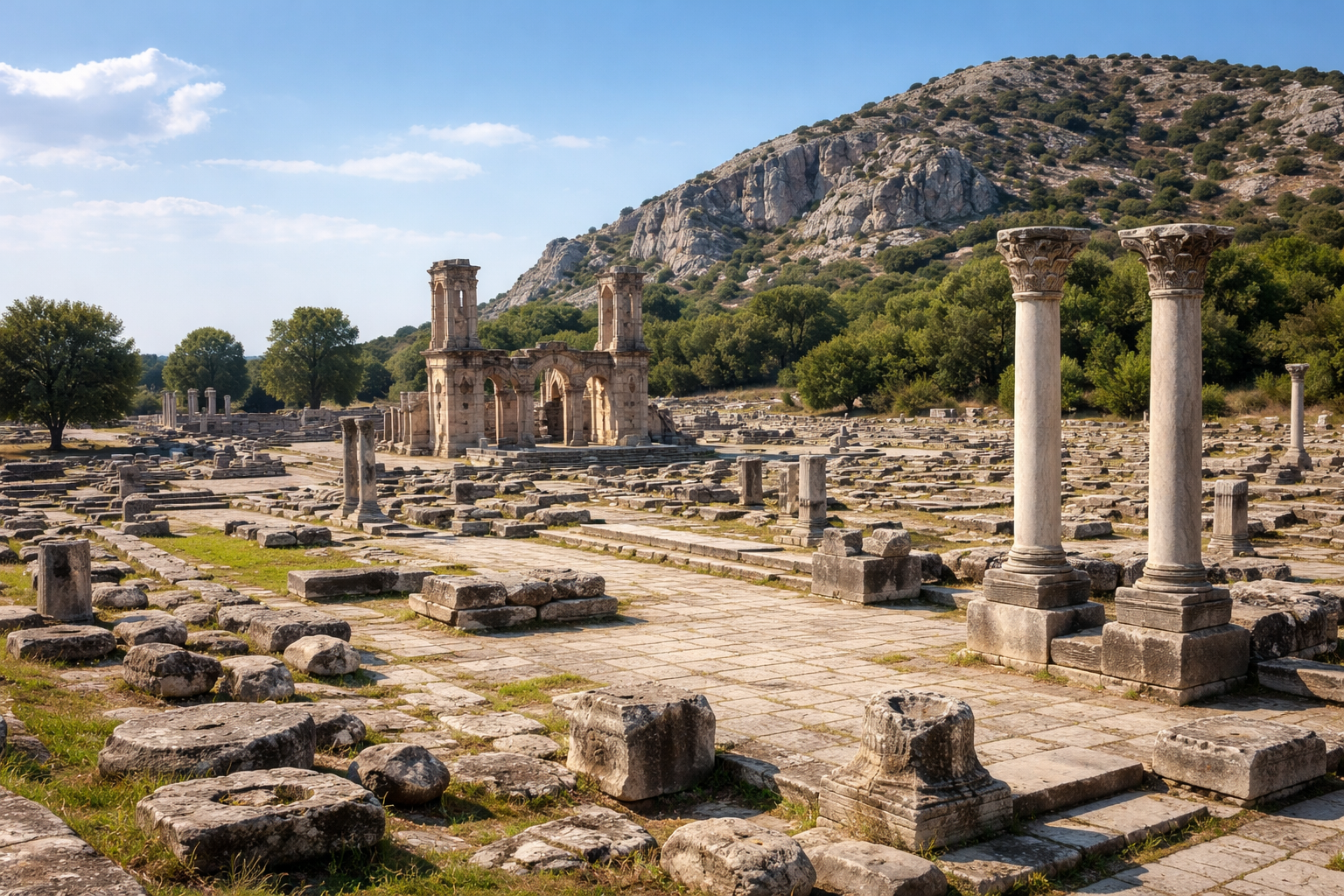
Philippi was a Roman colony. Its residents took pride in their Roman status even though they lived in Macedonia. Rome shaped their laws, culture, dress, and public life. Their identity came from elsewhere.
When Paul says, “Our politeuma is in heaven,” he is not speaking about going to heaven when we die. He is speaking about where our governing authority comes from.
Heaven, in Paul’s theology, is the sphere of the Messiah’s present reign.
So the church is:
- A colony of heaven within the present age
- A community shaped by the values of the coming kingdom
- A people whose primary allegiance is to Jesus as Lord
This means Christian identity is not private spirituality. It is political in the deepest sense — not partisan, but allegiance-defining.
Philippi was Rome in miniature.
The church is heaven in miniature.
And from that heavenly commonwealth, we “await a Savior” — a title once reserved for Caesar, now claimed by Christ alone.
The future hope is specified in 3:21: Christ “will transform the body of our humiliation to be conformed to the body of his glory.” The verb μετασχηματίσει, future active indicative, expresses confident expectation. Salvation culminates not in disembodied escape but in bodily transformation. Paul’s vision remains deeply Jewish and creational. Resurrection means the renewal of embodied existence, not its abandonment.11
The transformation is patterned: conformity (σύμμορφον) to Christ’s glorious body. What began in participation through suffering will culminate in participation through glory. Present weakness anticipates future transfiguration.12 This hope grounds perseverance. Christian ethics is eschatological: the body matters now because it will be raised and renewed.
Finally, this transformation occurs “by the power that enables him to subject all things to himself” (3:21). Cosmic lordship guarantees personal redemption. The same sovereign authority by which Christ brings creation into submission ensures the believer’s future conformity. Eschatology rests not on speculation but on the enthroned Messiah’s reign.13
Philippians 3:12–21 therefore holds together several decisive theological strands. It dismantles perfectionism by affirming ongoing incompletion. It rejects complacency by insisting on forward pursuit. It relativizes imperial identity by asserting heavenly citizenship. And it restores embodied hope by proclaiming resurrection transformation.
The church lives between cross and resurrection—between having been seized and being finally transformed. It presses forward not anxiously, but faithfully. The telos is secure; therefore, the race continues.
Not yet perfected—but held.
Not yet transformed—but destined.
And therefore always pressing on.
We press on not because we have arrived, but because we have been seized by a future that is already secure.
Footnotes
- George Eldon Ladd, The Presence of the Future (Grand Rapids: Eerdmans, 1974), 218–25. ↩︎
- James D. G. Dunn, The Theology of Paul the Apostle (Grand Rapids: Eerdmans, 1998), 481–86. ↩︎
- Gordon D. Fee, Paul’s Letter to the Philippians, NICNT (Grand Rapids: Eerdmans, 1995), 344–48. ↩︎
- Moisés Silva, Philippians, 2nd ed. (Grand Rapids: Baker Academic, 2005), 180–86. ↩︎
- Dunn, The Theology of Paul the Apostle, 490–94. ↩︎
- Joseph H. Hellerman, Reconstructing Honor in Roman Philippi (Cambridge: Cambridge University Press, 2005), 156–64. ↩︎
- Fee, Philippians, 358–63. ↩︎
- N. T. Wright, Paul and the Faithfulness of God (Minneapolis: Fortress Press, 2013), 1042–47. ↩︎
- Wright, Paul and the Faithfulness of God, 1248–55. ↩︎
- Hellerman, Reconstructing Honor in Roman Philippi, 156–64. ↩︎
- Dunn, The Theology of Paul the Apostle, 476–80. ↩︎
- Richard B. Hays, The Moral Vision of the New Testament (San Francisco: HarperCollins, 1996), 20–27. ↩︎
- Wright, Paul and the Faithfulness of God, 1311–18. ↩︎
AI-generated illustration of the Roman Forum at Philippi, produced using DALL·E (OpenAI), 2026.
Leave a Reply