Romans 14–16 and the Shape of True Christian Belonging
If there is one place where the early Christian movement announced its radical, world-reordering vision, it was at the table. In a world divided by ethnicity, status, purity boundaries, and competing loyalties, the shared meal of believers was a living sign that a new creation had already begun. Jew and Gentile, slave and free, men and women—all were welcomed as members of one family because the Messiah had welcomed them first.
And this is precisely why Paul labors so hard in Romans 14–16 to teach the Roman believers how to live together faithfully. Unity is not sentimental. It is the lived expression of the gospel itself. It is the public demonstration that what God has done in the Messiah—breaking down the dividing wall of hostility, forming a single humanity—is not merely an idea but a real community.
This vision raises a timely question for our own age: Would Christians who hold to a rapture-centered eschatology be welcomed at God’s table? For many modern believers, eschatology is one of the most emotionally charged and identity-forming areas of theology. Entire traditions, ministries, and subcultures have grown around specific end-times schemes. Some treat their eschatological vision as the essential mark of true faithfulness. Others treat it as a test of biblical literacy. Still others reject rapture teaching entirely.
But Paul’s teaching in Romans invites us into a deeper, richer framework—one in which eschatological differences are real and worth discussing, yet never allowed to undermine the unity that the gospel creates.
1. The Table Belongs to the Lord, Not to Our Interpretive Systems
Paul’s command in Romans 14:3 is both simple and seismic: “God has welcomed them.” The strongest argument for unity in the church is not that disagreements are small but that the people involved already belong to God. The Messiah has taken hold of them. They are his. Their place at the table is secured by his grace, not by their mastery of theological detail.
In Paul’s own context, the disagreements were profound. Some believers kept Torah food laws; others did not. Some observed sacred days; others saw no need. These were not light matters. They touched the entire Jewish narrative, the meaning of Scripture, and the identity of God’s people. And yet, Paul insists these differences are not grounds for exclusion.
If those intense disagreements were not enough to break table fellowship in Paul’s day, then disagreements about the timing and mechanics of the Messiah’s return today certainly should not.
Many who hold rapture-centered views share the same core confession as all Christians: Jesus is Lord, God raised him from the dead, and he will come again to restore creation. They trust Jesus, seek holiness, share the gospel, and hope for God’s renewal of all things. Whatever differences remain, the Lord has welcomed them—and that settles the matter.
2. What Paul Warns Against: Division Contrary to the Gospel
Yet Paul is not naïve. In Romans 16:17–20, he issues a firm warning: “Watch out for those who cause divisions contrary to the teaching you received.” Not every division is innocent. Some forms of teaching—however spiritual they may sound—pull God’s people away from the Messiah-centered reality Paul proclaimed.
The warning comes after Paul’s long discussion of diversity in the body of Christ. This order matters. Disagreements about practice, interpretation, or conscience do not fracture the church. But a posture that:
- elevates one group over another,
- claims exclusive spiritual insight,
- breeds pride rather than humility,
- or fractures the unity created by the gospel,
is something different altogether.
So the question is not: “Do rapturists hold the right eschatology?” The deeper question is: “What does their eschatology produce?”
If an end-times teaching:
- motivates holiness,
- inspires hope,
- strengthens faith,
- and leads believers to love one another,
It bears the kind of fruit Paul celebrates.
But if it:
- creates fear instead of courage,
- fosters superiority or division,
- encourages withdrawal from the world God is renewing,
- or becomes a badge of spiritual elitism,
then it begins to function as a distortion of the gospel—not because of its charts or timelines, but because of its effect on the community.
3. True Eschatology Creates Faithful Communities, Not Factions
Paul’s eschatology in Romans is not speculative. It is ethical, communal, and hopeful. The future God has promised has already broken into the present through the Messiah and the Spirit. Christian hope is not escape but transformation—of humans, communities, and creation itself.
This shapes how believers should live now:
- not in fear of the world,
- but as witnesses to the world’s coming renewal;
- not in withdrawal,
- but in Spirit-empowered love;
- not as spectators waiting to be removed,
- but as participants in God’s ongoing mission.
Whatever one’s expectations about the end, the present calling remains the same: to embody the life of the age to come here and now.
If rapture teaching encourages disengagement or despair, it misses the heart of Paul’s vision. But many rapturists do not live this way. They pray, serve, give, love, and witness. They look for Christ’s appearing not as escape from the world but as the moment when God finally sets things right.
4. Unity Is the Visible Sign of God’s New World
The Lord’s table is where God’s future becomes visible in the present. It is the preview of the great feast where people from every tribe and tradition will gather in joy. If we fence that table with doctrinal diagrams rather than with the Messiah’s welcome, we deny the very gospel we claim to defend.
Paul ends Romans with a promise far bigger than any human scheme: “The God of peace will soon crush Satan under your feet.” (Rom 16:20) The forces that divide, deceive, and distort are real—but God will overcome them. Our task is not to police the borders of the kingdom but to live faithfully within its reality.
Conclusion: The Table Is Wide Enough for the Whole Family
So, are rapturists welcome at God’s table?
Yes—because the table belongs to God, not to us. Their hope may be shaped differently, their expectations ordered differently, but if they belong to Christ, they belong to his people.
The deeper question is for all of us:
Does our eschatology, whatever its form, produce the kind of life that reflects the age to come?
If it leads to humility, faithfulness, love, and hope, then it serves the gospel well.
If it leads to pride, fear, or division, then we must hear Paul’s warning anew.
God has welcomed us—each of us—and that welcome shapes everything. Let us therefore welcome one another, not because we agree on every detail, but because Christ is Lord of all, and his table is wide enough for the whole family he has redeemed.
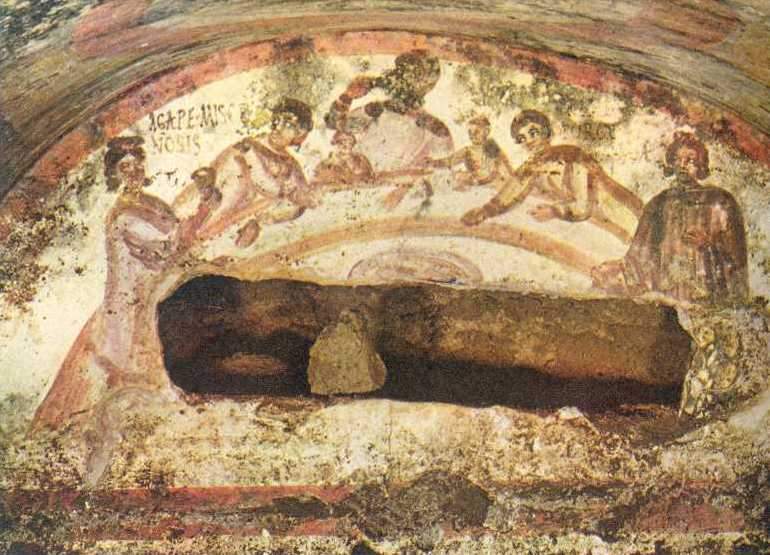
Image Credit: Agape Feast, fresco from the Catacomb of Saint Callixtus, Rome. Sourced from Wikipedia (public domain).
Leave a Reply