Romans 13 and Revelation 13 are not contradictions. They describe two faces of political power.
Romans 13 and Revelation 13 are not contradictions. They describe two faces of political power. In Romans 13, Paul speaks of governing authorities as God’s servants, entrusted with the task of restraining evil and preserving public order. In Revelation 13, John sees political power deformed into a beast—violent, self-exalting, and demanding allegiance that belongs only to God. The tension is not accidental. It is one of Scripture’s most important warnings about authority.
But the New Testament will not allow Romans 13 to be read in isolation.
The same Bible that calls governing authorities “God’s servants” in Romans 13 also portrays imperial power as a beast rising from the sea in Revelation 13—violent, blasphemous, deceptive, and demanding allegiance that belongs only to God. At first glance, the two chapters may seem irreconcilable. Is political authority God’s instrument for order, or is it a monstrous power animated by the dragon?
The answer, as F. F. Bruce observed in his essay “Paul and ‘The Powers That Be,’” is that we are looking at two faces of political power. The magistrate of Romans 13 and the beast of Revelation 13 are not simply opposites. Under certain conditions, Bruce says, we can indeed recognize the one in the other.¹ Political authority may serve God’s purpose by restraining evil and preserving public order. When political authority abandons justice, absolutizes itself, devours the weak, and demands unquestioning loyalty, it becomes beastly.
That distinction is crucial for Christian discernment in every age.
Political Authority Has a God-Given Vocation
Paul’s words in Romans 13 should not be dismissed. Government, in its proper vocation, is not a mere accident of human history. It belongs to God’s providential ordering of life in a fallen world. Authorities are meant to restrain wrongdoing, uphold what is good, and maintain a civic order in which ordinary people may live without constant fear of chaos or violence (Rom. 13:3–4).
Paul calls the ruler “God’s servant for your good.” That is a remarkable phrase. Political authority is not self-authorizing. It is not ultimate. It is ministerial—a delegated trust under God. The state does not possess moral legitimacy merely because it has power; it possesses legitimacy insofar as it serves the good for which power was entrusted.
This is why Christians need not be instinctively anarchic. Law, courts, public institutions, and civil order matter. A society without accountable authority does not become free; it becomes vulnerable to predation by the strongest. Scripture knows the horror of a world in which “everyone did what was right in his own eyes” (Judg. 21:25). Political authority, at its best, is one means by which God restrains the spread of disorder.
But Romans 13 does not give rulers unlimited authority. Paul does not say, “Whatever the authorities do is righteous.” He says they are God’s servants for good. That phrase is both a description and a standard. Authority has a vocation; therefore, it can betray that vocation.
Revelation 13 Shows What Power Becomes When It Forgets God
Revelation 13 gives us the other side of the biblical picture. John sees a beast emerging from the sea, receiving authority from the dragon, speaking arrogant words, making war on the saints, and drawing the world into worship. The imagery is apocalyptic, but its target is not difficult to discern. Revelation speaks from the shadow of Rome—an empire that advertised peace while ruling through military dominance, economic pressure, public spectacle, and the cult of imperial loyalty.
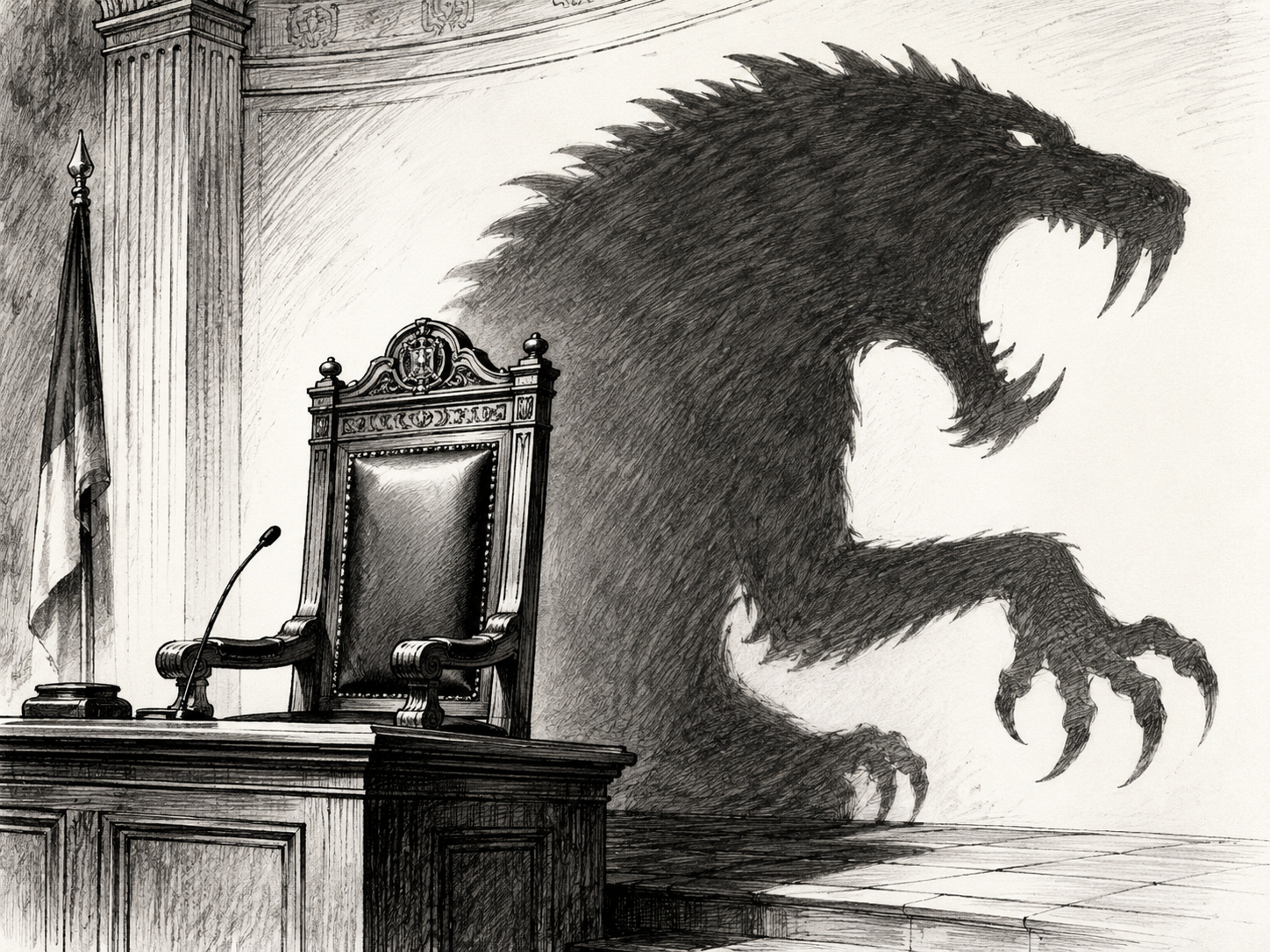
The beast is political power gone feral.
It is not government simply doing ordinary government things. It is authority claiming ultimacy. It is the state becoming an idol. It is power demanding not merely civic cooperation but the surrender of conscience. It is empire presenting itself as savior, judge, and source of life. It is rule detached from truth, justice, and the fear of God.
This is why Revelation 13 does not contradict Romans 13. It reveals what happens when Romans 13 is violated from the side of the ruler.
Romans 13 describes political authority within its proper vocation. Revelation 13 portrays political authority after it has corrupted that vocation.
The same institution that can punish wrongdoing may begin to punish truth. The same sword entrusted to restrain violence may be turned against the innocent. The same public office meant to serve the common good may become a shield for impunity. The same rhetoric of “peace and order” may become cover for dehumanization. The same state that should protect the vulnerable may learn to treat them as expendable.
That is the beast.
The Cross Exposes Both the Abuse of Power and the False Innocence of Institutions
The crucifixion of Jesus is the clearest unveiling of this tragic possibility. At the cross, multiple forms of authority converge: imperial authority, local political calculation, compromised religious leadership, crowd manipulation, and the machinery of public execution. Each participant can claim to be preserving order. Yet together they condemn the Innocent One.
Rome does not crucify Jesus because he is a violent insurrectionist in the ordinary sense. Pilate repeatedly sees that the case is thin. Yet political expediency wins. Better to sacrifice one inconvenient man than risk unrest. Religious leaders do not reject Jesus because they love wickedness for its own sake. They convince themselves that preserving the nation and their sacred order requires his removal. The crowd does not need to know every detail; it need only be steered.
And so the Lord of glory is crucified (1 Cor. 2:8).
This is how the powers work. They do not always appear as naked evil. They often clothe themselves in legality, procedure, necessity, and respectable language. They say, “This is for stability.” “This is for security.” “The goal is to protect the people.” Yet the cross asks a devastating question: What kind of order must kill the righteous to preserve itself?
Paul says that at the cross Christ “disarmed the rulers and authorities and made a public spectacle of them” (Col. 2:15). Rome thought it was exposing Jesus as powerless. In truth, the cross exposed the powers. It revealed what political, religious, and social systems become when they are more committed to self-preservation than to truth.
The resurrection is God’s verdict on that whole arrangement. Jesus is vindicated. The powers are judged. The system that called him disposable is shown to be wrong.
Submission Is Not Worship
This is why Christian submission to authority can never mean absolute obedience. Romans 13 must be read alongside the apostles’ declaration in Acts: “We must obey God rather than men” (Acts 5:29). The early Christians were not rebels by temperament. They prayed for rulers, paid taxes, and sought peace. But they refused to confess Caesar as Lord because Jesus alone is Lord.
That confession is politically significant.
To say “Jesus is Lord” is not a slogan for partisan domination. It is a declaration that no ruler, no government, no court, no party, no nation, and no charismatic leader possesses ultimate claim over the human person. All authority is derivative. All rulers are accountable. All power stands beneath the judgment of the crucified and risen Messiah.
Christians may honor office without idolizing office. They may respect institutions while acknowledging that institutions can become corrupt. They may seek social peace without calling injustice “peace.” They may submit to lawful authority without surrendering moral discernment. They may refuse chaos without blessing tyranny.
The church fails its witness when it quotes Romans 13 to protect the powerful but forgets Revelation 13 when the powerful become predatory.
The State Is Not the Kingdom of God
Scripture can speak positively about government without confusing it with God’s kingdom. The state may restrain wrongdoing, preserve public order, and administer a measure of justice. These are real goods. But it cannot reconcile enemies, renew the human heart, or bring new creation. Those belong to the reign of God revealed in the crucified and risen Christ. Political authority is therefore important, but never ultimate. Christians may work for just institutions and responsible public life, yet our deepest hope does not rest in rulers, parties, or nations. It rests in the Messiah whose kingdom judges every power and outlasts every throne.
When Political Power Turns Beastly
How, then, do we discern when authority is serving its vocation and when it is becoming beastly?
Not every policy error is Revelation 13. Not every unpopular leader is a beast. Christian discernment must be sober, not theatrical. But Scripture does give us signs.
Power becomes beastly when it treats human beings as disposable.
When the poor become statistics, it is a troubling reality.
When victims are forgotten because their pain is politically inconvenient.
When truth is buried under propaganda.
When public office becomes a refuge from accountability rather than a trust before God.
When loyalty to a leader matters more than loyalty to justice.
When institutions close ranks not to protect the common good, but to shield impunity.
When law is invoked selectively—strict for the weak, flexible for the powerful.
When moral outrage is dismissed as disloyalty.
When the state begins to demand silence where God demands witness.
In such moments, Christians should not let those who weaponize Romans 13 intimidate them as though the Bible requires passivity before injustice. Romans 13 itself condemns rulers who stop being servants “for good.” Revelation 13 tells us that political power, when severed from justice, can become monstrous. And the cross tells us that such powers may appear triumphant precisely when they are being exposed.
A Word for Our Present Moment
This is not merely a first-century debate. It presses upon us now.
In every society, including our own, we see moments when deception, impunity, and the erosion of human dignity increasingly shape public life. The issue is not whether Christians should become partisan mouthpieces. We should not. The issue is whether Christians can still recognize the moral difference between authority that serves justice and authority that protects itself at the expense of the vulnerable.
The gospel does not train us to be gullible citizens. Nor does it train us to be cynical agitators. It forms us into truthful witnesses.
We are called to pray for rulers because they need wisdom and because power is spiritually dangerous. We are called to obey just laws because social order is good. We are called to honor public office because authority is a trust. But we are also called to speak when power forgets its purpose, when law is bent away from justice, and when human beings made in God’s image are treated as obstacles to be removed.
Silence in such moments is not neutrality. It can become an accommodation to the beast.
The Church Must Learn to Read Both Chapters
The church needs Romans 13, lest it romanticize disorder and treat all authority as evil. But the church also needs Revelation 13, lest it romanticize rulers and treat all authority as righteous. Read apart, either chapter can be abused. Read together, they give us a mature theology of political power.
Romans 13 says: authority is accountable to God because it is meant to serve the good.
Revelation 13 says: authority becomes demonic when it claims ultimacy and devours those it was meant to protect.
The cross says: such powers have already been exposed.
The resurrection says: they will not have the final word.
The Christian posture is discernment under the lordship of Christ, avoiding both naïve trust in power and hopeless fear of power.
Government may be God’s servant. But it is never God.
The state may restrain evil. But it can also become evil’s instrument.
Authority may deserve respect. But only Christ deserves worship.
And whenever political power forgets that distinction, the church must remember it aloud.
Footnotes
- F. F. Bruce, “Paul and ‘The Powers That Be,’” Bulletin of the John Rylands Library 66, no. 2 (1984): 78–96. Bruce famously asks whether Paul’s “minister of God” in Romans 13 may be recognized in John’s “beast from the abyss” in Revelation 13 and answers, “We can indeed.”
Featured image generated with AI assistance for this article.
“When Authority Casts a Beastly Shadow” — an illustration symbolizing political authority corrupted by power.
Leave a Reply